Haunting Brightness in the House the Fresco Restorer Abandoned
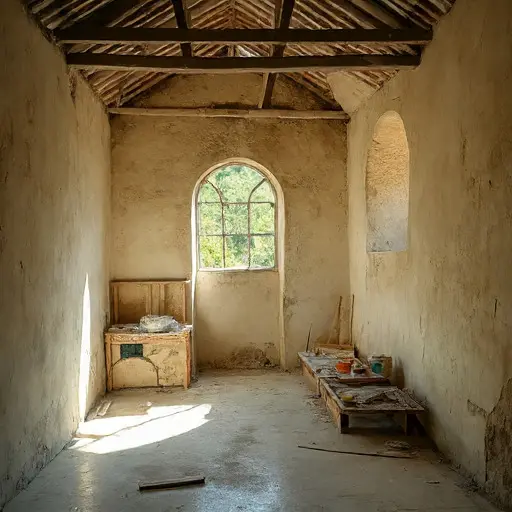
The walls are still half-colored.
Not ruined.
Not completed.
Some sections hold restored saints and landscapes, while others remain raw plaster—waiting for pigment that never arrived.
This house belonged to Elena.
She worked as a fresco restorer, repairing aging wall paintings in small chapels, rural estates, and historic interiors.
The studio was built directly into the house.
Pigments lined shallow shelves sorted by mineral source. Lime plaster trays rested beside cloths stained with centuries of color. Scaffolding poles leaned against walls marked with faint outlines of unfinished restoration work.
The entire home functioned as both shelter and conservation space.
Living room.
Workshop.
Archive.
All overlapping.
Beneath the Ochre Arch Frame
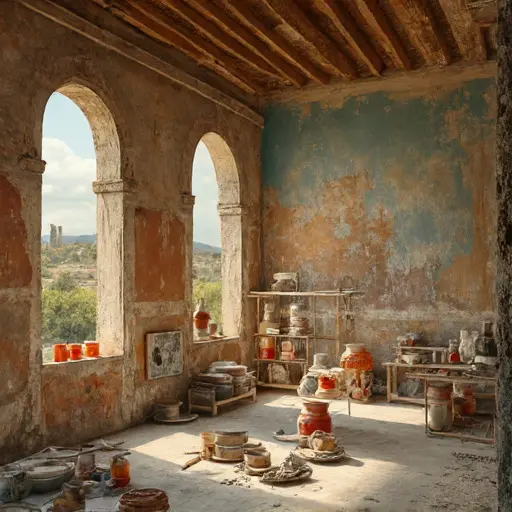
Elena worked most often beneath the Ochre Arch Frame.
The curved structural arch supported her main restoration wall, where she mapped pigment layers and tested mineral mixtures against centuries-old plaster.
Her partner passed away early.
After that, she stopped traveling for large commissions.
For years the profession still had purpose.
Small chapels and heritage buildings required careful restoration to preserve fading religious and cultural imagery before full decay set in.
Then funding collapsed.
Cultural maintenance budgets were cut, and restoration projects were postponed indefinitely or handed to cheaper surface repainting crews that erased rather than repaired history.
Elena continued anyway.
Working alone.
Slower.
More precise.
But the work itself began to vanish.
Buildings were repurposed instead of preserved. Chapels were converted. Estates modernized. Walls were painted over instead of restored.
The frescoes stopped being valued as living surfaces of memory.
Then the roof weakened.
Seasonal seismic shifts and long-term structural fatigue affected many older hillside buildings in the region, leading to partial closures and restricted access. Elena’s own restoration site became unsafe for extended scaffold work.
She reduced her time on the wall.
Moved closer to desk studies.
Then to pigment records.
Then only observation.
One final section of fresco remained unfinished above the Ochre Arch Frame—a fragment of sky she had been blending for years using rare lapis mixtures that never fully matched the original tone.
She died after a prolonged illness that worsened during a particularly damp winter season when mold spread through several untreated sections of the studio walls.
No one resumed her work.
The chapel-house was sealed.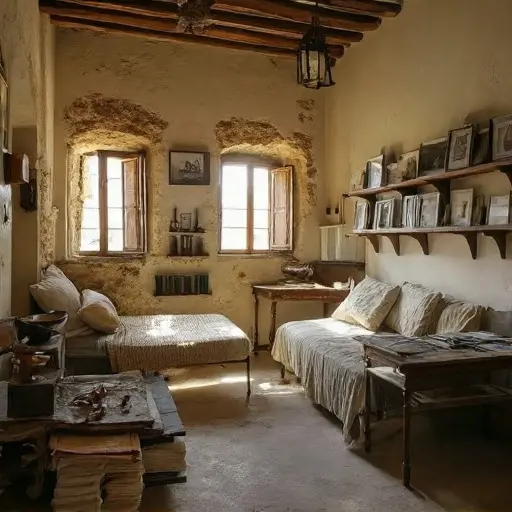
The pigment jars remain sealed.
The scaffolding still leans against the wall.
And beneath the Ochre Arch Frame, Elena’s unfinished sky continues waiting in silence—holding the last color she never returned to place back into history.