Monstrous Quiet Waited Inside the Courtyard House Where Laleh Traced the Language of Pomegranates

The seeds are arranged in spirals.
Nobody understands why at first.
Dried pomegranate seeds rest inside shallow trays scattered throughout the chamber—not randomly, not artistically, but according to some forgotten geometry whose purpose feels almost ceremonial.
Laleh understood it.
The courtyard house belonged to her.
She lived there alone and practiced a profession that once stood quietly between agriculture, symbolism, and inheritance.
Laleh was a fruit omen taxonomist.
Her work involved documenting symbolic and environmental patterns found in harvested fruit—particularly pomegranates used in family rituals, seasonal observances, and orchard traditions. Shape, seed arrangement, skin tension, and ripening anomalies were interpreted not as prophecy, but as ecological and cultural information.
She classified meaning through harvest.
The fruit chamber still reflects her precision.
Seed trays rest beside brass calipers. Skin journals remain tied with silk cord. Drying racks line the walls beneath shelves carrying labeled rind fragments sorted by orchard, rainfall, and maturation pattern.
The room feels observational rather than mystical.
Through the Crimson Kernel Gallery
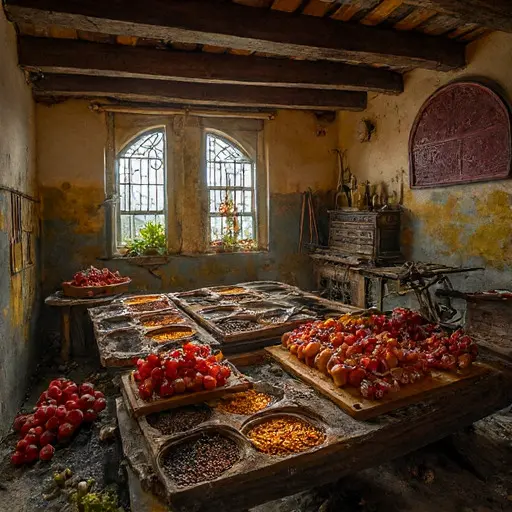
Laleh preferred working through the Crimson Kernel Gallery.
The narrow passage between drying shelves remained naturally ventilated and preserved delicate specimens from collapse during classification.
One unfinished taxonomy still rests there.
The rind preserved.
The symbolic sequence incomplete.
Laleh inherited fragments of the profession through orchard families who believed fruit carried layered histories of weather, soil, and household continuity.
People remembered her fingertips stained crimson during harvest months.
For decades the work survived.
Ceremonial households and orchard keepers still valued symbolic classification tied to seasonal agriculture and family custom.
Then commerce accelerated.
Supermarket grading systems, export uniformity, and industrial fruit selection steadily displaced localized interpretation and heirloom variation. Fruit became standardized merchandise instead of narrative.
Laleh disliked perfect produce.
She said flawless fruit forgot struggle.
Still, she continued preserving and documenting unusual harvest patterns long after commissions faded.
Then the bees faltered.
Pesticide overuse and collapsing pollinator populations disrupted orchard fertility throughout the surrounding valleys. Fruit forms grew inconsistent, harvests weakened, and familiar symbolic patterns disappeared.
The trees survived.
Their language fractured.
Already living with advanced multiple sclerosis and increasing weakness in her hands, Laleh spent longer afternoons inside the gallery sorting specimens she could barely hold.
One harvest season she remained working during a severe dust storm after sealing fragile collections along the passage.
The storm blocked airflow and aggravated her respiratory distress before neighbors realized she was alone.
She died quietly among the drying racks.
The funeral gathered growers, widows, and elderly orchard families who still remembered Laleh naming fruit varieties no market catalog preserved.
The house remained afterward.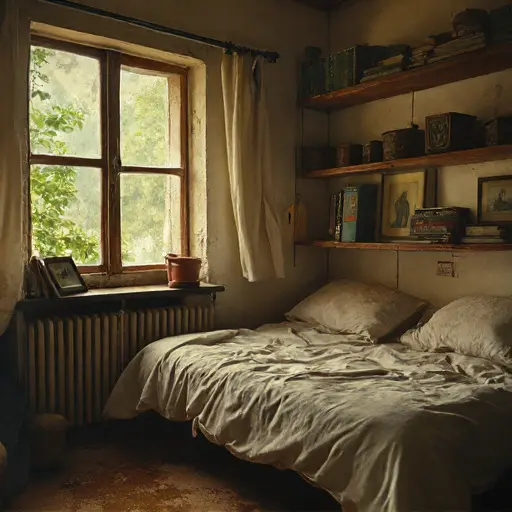
The brass calipers remain beside the trays.
The rind journals still rest beneath their cords.
And through the Crimson Kernel Gallery, Laleh’s unfinished fruit taxonomy continues waiting in silence—holding seeds she never returned to teach the world how to read.