Ruinous Silence Waits in the Stone Cottage Where Anika Bottled the Weight of Morning
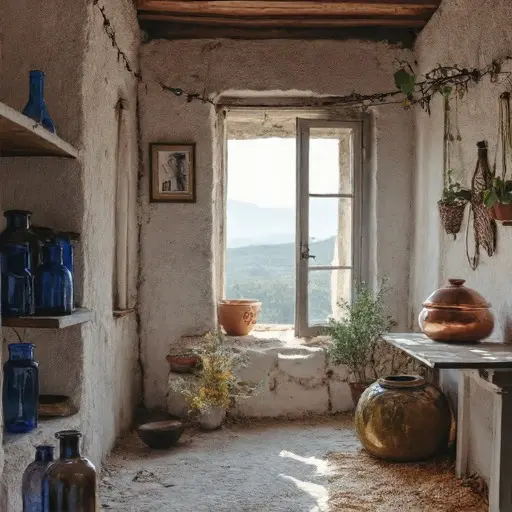
The bottles cloud before sunrise.
No one understood why.
By afternoon they appear ordinary—thin blue glass lined neatly across cedar shelves.
But during early morning, a pale film gathers inside them as though the room itself continues breathing through old habits.
Anika claimed dawn possessed texture.
The stone cottage belonged to her for nearly thirty years.
She lived alone and practiced a profession so fleeting most people dismissed it as poetic nonsense.
Anika was a dew distiller.
Her work involved collecting, preserving, and classifying natural dew for medicinal gardens, cosmetic preparations, and environmental observation. Different plants, elevations, and atmospheric conditions produced distinct condensations once valued by healers and growers.
She harvested morning before it disappeared.
The dew room still preserves her rituals.
Glass funnels hang from iron hooks. Linen filters remain folded beside collection trays. Humidity journals lie stacked beneath shelves carrying dozens of labeled vials arranged by hillside, season, and moon phase.
The room feels fragile.
Almost temporary.
Along the Silver Throat Shelf

Anika worked along the Silver Throat Shelf.
The narrow ledge beneath the eastern shutters remained coolest before dawn and allowed collected condensation to stabilize before transfer.
One unfinished distillation still rests there.
The droplets gathered.
The purity notation absent.
Anika inherited neither property nor profession.
She learned through apprenticeship with herbal households who treated dew as environmental memory rather than simple moisture.
People remembered her walking the groves before birds fully woke.
For decades the work survived.
Medicinal gardens and botanical traditions still valued natural condensates linked to plant behavior and local climate.
Then chemistry standardized.
Industrial extraction, laboratory synthesis, and commercial cosmetic production steadily displaced naturally collected atmospheric preparations. Dew became romantic rather than useful.
Anika disliked bottled fragrance.
She said laboratories forgot patience.
Still, she continued distilling and documenting dawn moisture long after interest faded.
Then the night lights spread.
Expanding resort development and artificial illumination altered local insect cycles and plant behavior throughout surrounding groves. Condensation patterns shifted unpredictably and dew quality changed in ways Anika struggled to classify.
The mornings remained.
Their balance altered.
Already living with severe lupus and increasing kidney failure, Anika spent longer predawn hours gathering increasingly elusive samples.
One summer morning she climbed the hillside terraces before daylight after weeks of unstable health, determined to compare altered dew patterns near abandoned groves.
Her basket and filters were later found beside the path.
She never returned to the cottage.
The funeral gathered herbalists, growers, and elderly women who still remembered washing seedlings with dew Anika collected decades earlier.
The cottage remained afterward.
The funnels still hang from their hooks.
The journals remain beneath the shelf.
And along the Silver Throat Shelf, Anika’s unfinished dew distillation continues resting in silence—holding the last moisture of a morning she never returned to bottle.