Vicious Quiet Trails Through the Longhouse Where Aroha Preserved the Memory of Driftwood
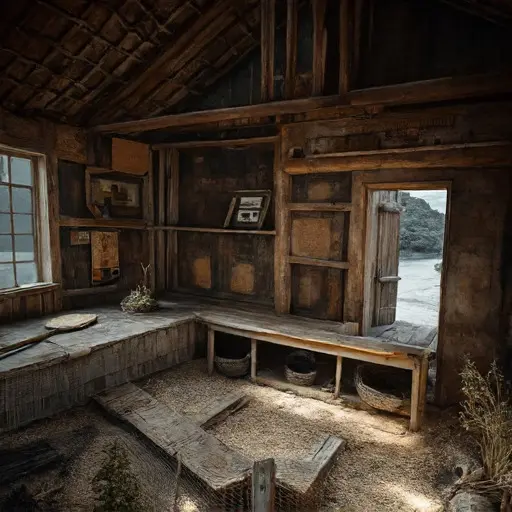
The wood is numbered.
Not stacked.
Not stored.
Numbered.
Every driftwood branch resting inside the carving room carries faded charcoal markings—dates, tide symbols, and abbreviated shoreline names written in careful script along grain polished by salt and years.
Aroha insisted driftwood had biography.
The longhouse belonged to her.
She lived there alone and practiced a profession that survived quietly along coasts before industrial shore management erased much of its meaning.
Aroha was a driftwood provenance keeper.
Her work involved tracing and preserving the origin stories of significant driftwood gathered from coastal currents. Communities, ceremonial artists, and maritime historians once relied on specialists like her to identify where wood traveled, what waters shaped it, and how it connected distant shores.
She catalogued movement through timber.
The carving room still carries her patience.
Tide maps hang beneath shell pins. Sanding stones remain beside carving knives. Drift ledgers lie open near shelves carrying samples sorted by current, bark remnants, and salt density.
The room feels tidal.
As though the ocean continued entering quietly through memory alone.
Beyond the Saltgrain Ledger Shelf
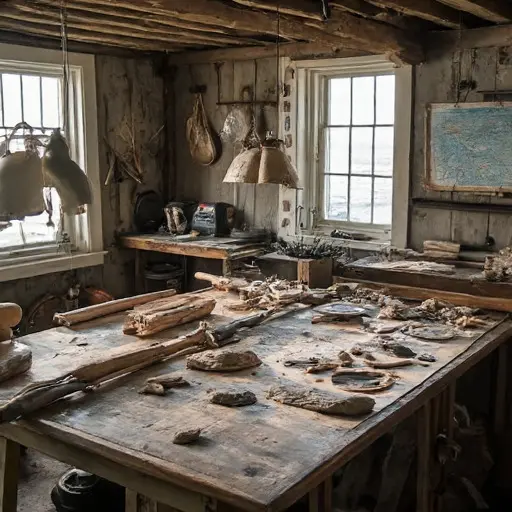
Aroha worked beside the Saltgrain Ledger Shelf.
The low shelving remained sheltered from moisture swings and held the most uncertain specimens awaiting classification.
One unfinished record still rests there.
The timber identified.
The arrival current unresolved.
Aroha inherited fragments of the craft through shoreline elders and canoe builders who treated driftwood not as debris but as witness.
She became known for walking beaches at dawn carrying chalk and measuring cord.
For decades the work endured.
Coastal artisans and cultural historians still valued provenance and material continuity tied to sea travel and oral tradition.
Then the shorelines hardened.
Concrete sea defenses, mechanized beach cleaning, and commercial coastal engineering steadily disrupted natural drift patterns and removed the accumulation zones Aroha depended upon. Wood vanished before stories could form around it.
She adapted poorly.
A cleaned beach saddened her.
Still, she continued collecting and documenting smaller finds.
Then the currents shifted.
Ocean warming and altered storm circulation transformed regional drift routes entirely, bringing unfamiliar debris while silencing pathways she had mapped for decades.
The beaches remained.
Their language changed.
Already living with severe rheumatoid degeneration and recurring cardiac weakness, Aroha spent longer mornings alone along unstable shoreline paths.
One winter dawn she ventured out after heavy surf hoping to confirm a rare current return she had predicted from older records.
Her basket was found later near the rocks.
She never returned to the longhouse.
The funeral gathered carvers, fishers, and elders who still remembered wood she traced back to shores nobody alive had visited.
The house remained closed afterward.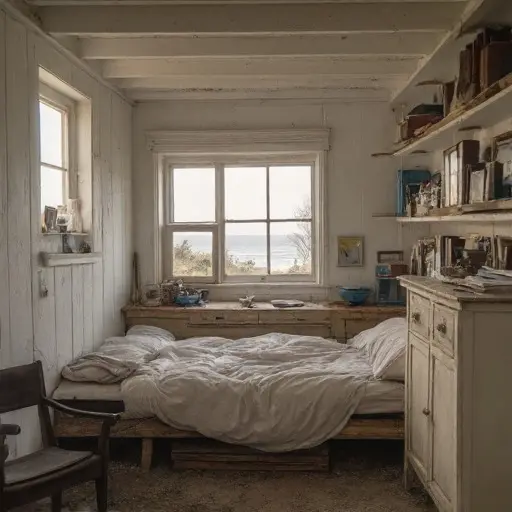
The carving knives remain beside the stones.
The tide maps still cling beneath shell pins.
And beyond the Saltgrain Ledger Shelf, Aroha’s unfinished driftwood record continues waiting in silence—holding a shoreline journey she never returned to finish translating.