Feral Silence Watches the House Where Eliska Harvested the Voice of Linen
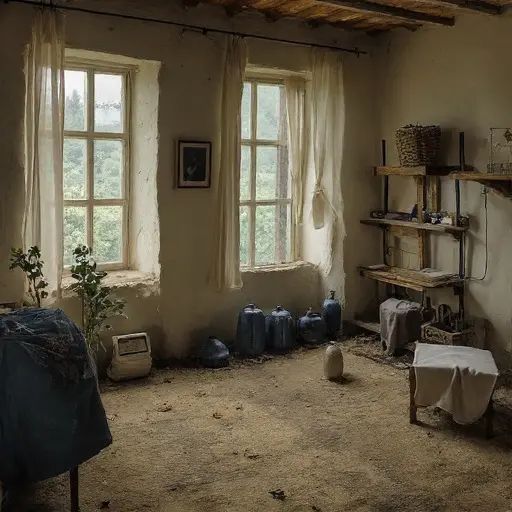
The cloth still rustles.
Not from wind.
From memory.
At least that is what neighbors once claimed.
Long strips of pale linen hang across the room, untouched for years yet somehow capable of carrying sound differently than ordinary fabric.
Eliska never called it superstition.
She called it resonance.
The countryside house belonged to her for nearly thirty-five years.
She lived there alone and practiced a profession forgotten so thoroughly most archives never recorded it properly.
Eliska was a linen acoustician.
Her work involved cultivating, preparing, and testing woven linen intended for acoustic interiors—performance halls, sacred chambers, and ceremonial rooms where fabric softened or carried sound with deliberate precision.
She did not weave clothing.
She wove listening.
The textile room still preserves her discipline.
Spinning frames stand beside sound boards. Flax samples remain tied with faded thread. Resonance ledgers rest near shelves carrying rolls marked by density, harvest season, and tonal response.
The room feels suspended between agriculture and architecture.
Near the Whisper Shuttle Alcove
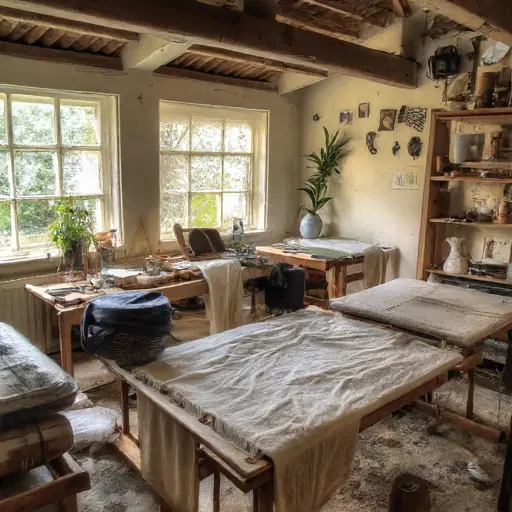
Eliska worked nearest the Whisper Shuttle Alcove.
The recessed corner protected sensitive cloth from abrupt humidity and allowed her to test vibration against stretched linen panels.
One unfinished fabric still rests there.
The weave complete.
The tonal grading absent.
Eliska inherited the profession through generations of flax growers and textile workers who believed certain fabrics possessed measurable acoustic temperament.
She became known among restorers and musicians for touching cloth before speaking about it.
For decades the work survived.
Historic interiors and performance spaces still commissioned handmade acoustic linen designed through observation rather than industrial specification.
Then materials changed.
Synthetic sound-dampening products, engineered wall systems, and mass-produced acoustic textiles steadily replaced labor-intensive linen preparation. Handmade resonance cloth became economically impractical.
Eliska disliked synthetics.
She said they silenced rooms without understanding them.
Still, she continued growing flax and grading fiber long after commissions faded.
Then the river poisoned.
Chemical runoff from upstream manufacturing contaminated irrigation feeding surrounding flax fields and altered the fiber quality that her work depended upon. Harvests weakened. Texture changed.
The linen lost its voice.
Already living with advanced neuropathy and worsening circulation problems, Eliska continued testing damaged cloth alone inside the room.
One harvest evening she remained working after dark beside the alcove while treating newly washed fiber.
A ruptured heating pipe filled the room with steam and scalding water before she could escape.
She died before neighbors reached the house.
The funeral gathered musicians, farmers, and elderly restorers who still remembered halls lined with linen she had prepared decades earlier.
The house remained closed afterward.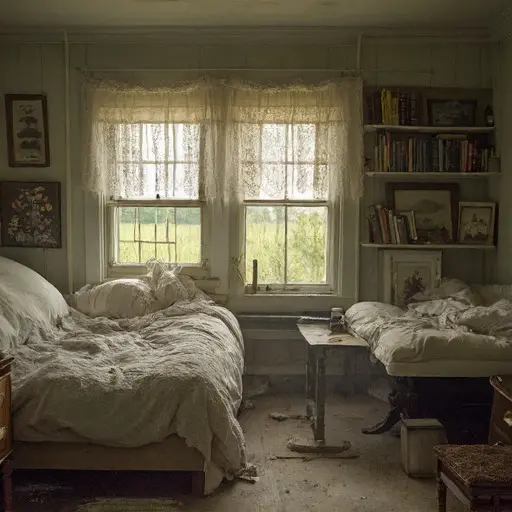
The flax samples remain tied with thread.
The resonance boards still lean against the wall.
And near the Whisper Shuttle Alcove, Eliska’s unfinished linen continues hanging softly—holding a sound she never returned to teach the room how to carry.