The Obscure Cottage Above the Heather Cliffs Never Lost Agnes’s Last Horizon
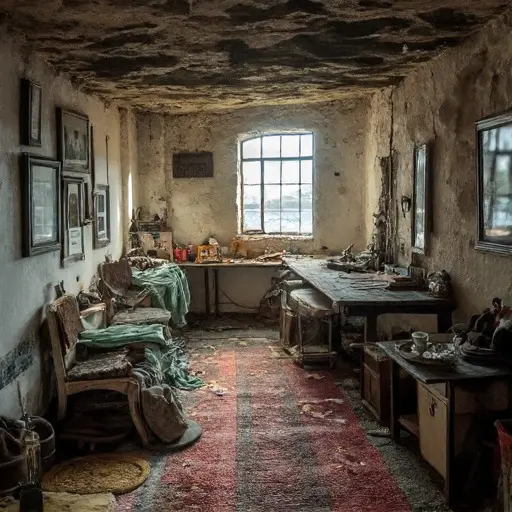
The lines climbed the walls.
Not cracks.
Not ivy.
Lines.
Thin charcoal trajectories ran upward beside shelves and disappeared toward the ceiling beams, intersecting at angles that made no sense until someone noticed the notebooks.
Agnes drew them.
The cliff cottage belonged to her for nearly thirty-five years.
She lived there alone and practiced a profession once valued by people who trusted cliffs more than maps.
Agnes was a seabird glide cartographer.
Her work involved recording the habitual aerial paths of coastal birds—especially those used by fishers, weather observers, and ecological caretakers who relied on flight behavior to understand currents, shoals, and approaching changes offshore.
She mapped movement in the sky.
The drafting room still carries that obsession.
Flight journals remain stacked beneath the desk. Feather-weight measuring pendulums hang beside windows. Coastal sketches and migration diagrams occupy nearly every shelf.
Nothing inside feels accidental.
Even the chair faces upward.
Beside the Wind Trace Hearth
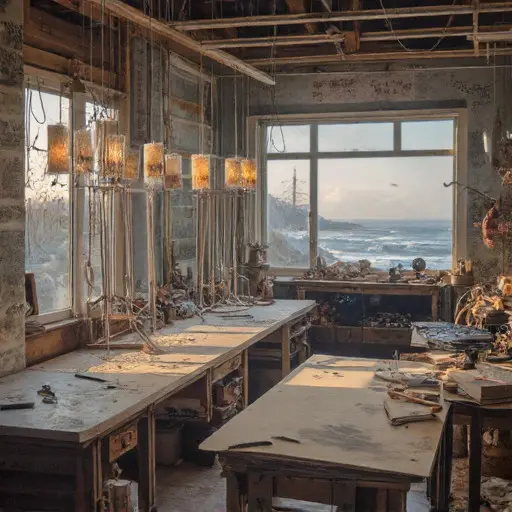
Agnes worked closest to the Wind Trace Hearth.
The old fireplace no longer burned fuel. Instead, she used the rising drafts near its chimney to suspend lightweight indicators that helped model lift and directional airflow.
One unfinished aerial chart still hangs there.
Northern glides complete.
Southern crossings absent.
Agnes had once accompanied lighthouse crews and shoreline surveyors before settling permanently in the cottage after her father died.
Locals remembered her binoculars more than her face.
For decades, the work mattered.
Fishing cooperatives and ecological researchers still valued long-term observational knowledge tied to bird behavior and marine conditions.
Then algorithms replaced watching.
Satellite wildlife tracking, predictive marine software, and automated ecological modeling gradually displaced human flight observation. Funding shifted toward digital systems and fewer people learned how to read movement directly from the coast.
Agnes resisted the transition.
She said numbers noticed patterns but missed personality.
Still, she continued walking the cliffs.
Then offshore turbines arrived.
Expanding wind infrastructure altered migratory routes and disrupted long-familiar aerial corridors that Agnes had documented for decades. Some species shifted entirely. Others stopped appearing near the cliffs.
Her charts became archives instead of guides.
Already living with worsening osteoporosis and chronic pain, Agnes refused to stop climbing the shoreline.
One fog-heavy morning she ventured onto the cliff paths after weeks of poor weather, hoping to confirm an unusual migration pattern she had been tracking.
She never returned.
Searchers later found her satchel near the rocks below.
The funeral gathered birders, retired fishers, and schoolchildren who remembered her teaching them how to follow gulls without speaking.
The cottage remained closed.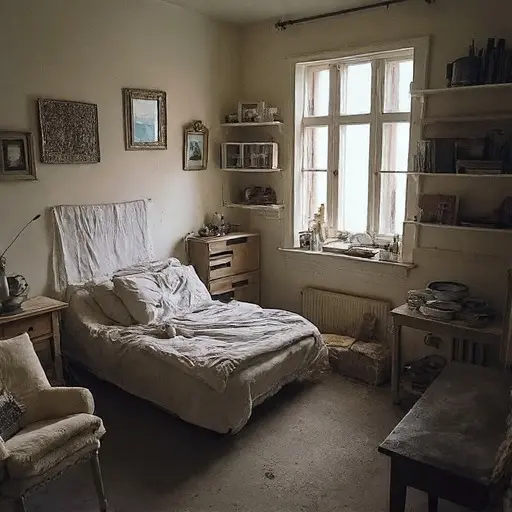
The pendulums still hang near the window.
The charcoal lines remain along the walls.
And beside the Wind Trace Hearth, Agnes’s unfinished glide chart continues reaching toward a horizon she never returned to finish drawing.