The Phantom House Near the Tamarind Canal Still Guards Celina’s Unfinished Current
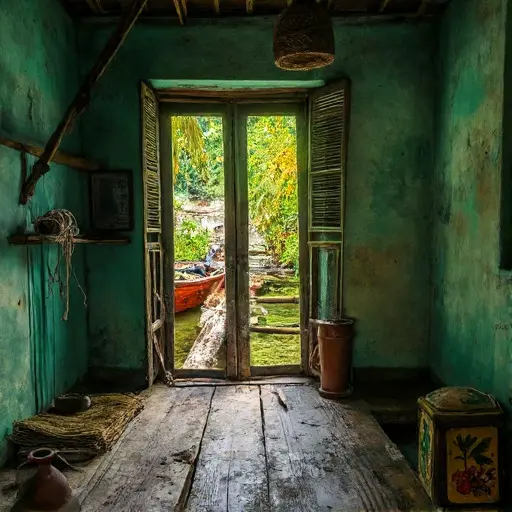
The strings crossed the room before anyone noticed the maps.
Fine cords stretched from wall to wall.
Some dipped toward bowls of water.
Others disappeared beneath shelves where glass markers and river stones waited beneath dust.
The house beside the canal belonged to Celina Arroyo.
She lived there alone and practiced a profession built around movement no one could hold.
Celina was a freshwater current mapper.
Not the modern kind.
Her work predated digital hydrology and served fishing communities, ferrymen, and river caretakers who needed hand-built models of local water behavior. She translated current shifts into suspended diagrams using string, weighted markers, and basin simulations that showed how rivers changed through season and tide.
She modeled motion.
Not geography.
The workshop still carries the shape of flow.
Water basins remain balanced on wooden stands. Marker stones sit inside labeled trays. Reed pens and tide notebooks occupy shelves stained by years of humidity and careful spills.
Nothing inside feels decorative.
Everything points somewhere.
Beneath the Driftline Table
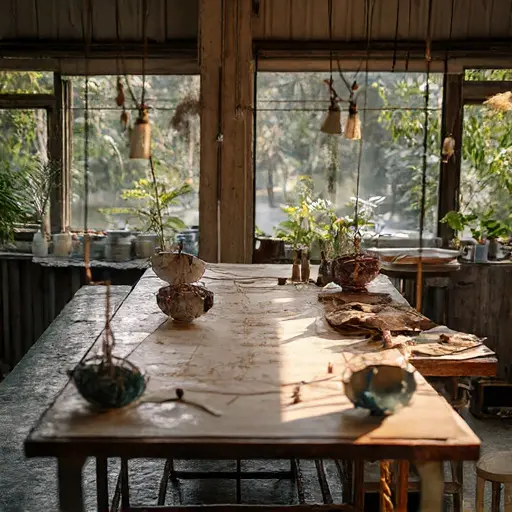
Celina worked around the Driftline Table.
The long table occupied the center of the room where suspended models could stretch uninterrupted from beam to beam.
One unfinished current study still hangs there.
The upstream markers placed.
The downstream pull unresolved.
Celina had once traveled constantly between river settlements carrying folded diagrams and portable basin frames.
Boat owners trusted her instincts more than official charts.
For decades, the work survived.
Communities relied on localized knowledge and seasonal interpretation where larger navigation systems remained unreliable or absent.
Then infrastructure hardened.
Concrete embankments, mechanized dredging, and centralized water engineering steadily replaced small-scale river knowledge. Standardized hydrographic systems reduced demand for handmade current mapping.
Celina disliked engineered certainty.
She said rivers never agreed to straight lines.
Still, she continued.
Then the silt changed.
Upstream mining and sediment disruption altered water clarity and flow behavior across the canal system, damaging fisheries and destabilizing long-familiar channels.
The river she knew became unfamiliar.
Already coping with advanced arthritis and recurring fever linked to waterborne illness, Celina spent longer hours rebuilding her models indoors.
One flood season brought severe overflow after weeks of erratic rain.
She remained inside trying to protect her suspended studies while water entered the lower rooms.
By morning, she had drowned inside the workshop she refused to abandon.
The funeral gathered ferrymen, fish sellers, and aging boat captains who still remembered her diagrams pinned inside cabins.
The house remained afterward.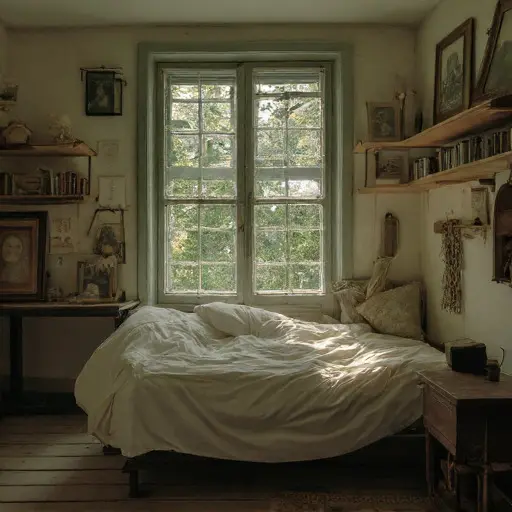
The strings still cross the room.
The basins remain balanced on their stands.
And beneath the Driftline Table, Celina’s unfinished river model continues hanging in silence—holding a current she never finished teaching the world to follow.