Mysterious Silence Lingered Inside Mara’s Hill House Long Before Anyone Claimed It
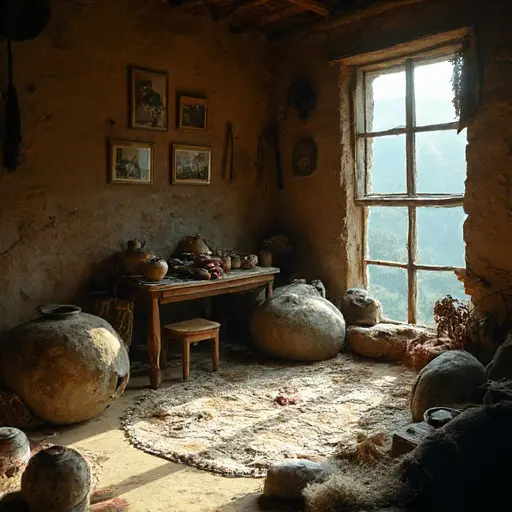
The first thing visitors notice is the compass.
Not a sailor’s compass.
A wooden one.
Its brass needle sits beneath cracked glass on a narrow table near the wall, surrounded by strips of faded fabric and shallow bowls filled with tiny stones.
No one remembers why Mara kept it there.
But no one moved it either.
The hill house belonged to Mara Quispe, who lived there for almost twenty-seven years and spent most of that time doing work difficult to explain to strangers.
Mara was a ceremonial path ribbon balancer.
During seasonal pilgrimages and mountain processions, long ribbons were fastened to staffs, arches, and devotional markers. Their movement mattered. Too heavy and they sagged. Too light and they tangled or snapped in wind. Mara tested balance, weight, and tension so the ribbons carried symbolic motion instead of chaos.
It was delicate work disguised as decoration.
Her studio occupied the brightest room in the house.
Fabric rolls remained stacked beside carved pegs. Weight stones rested inside bowls worn smooth from handling. Dye marks stained the edges of tables where she trimmed, folded, and tested movement for hours.
She believed fabric behaved differently depending on altitude and weather.
People laughed at that.
Then they hired her anyway.
Where the Needle Slept
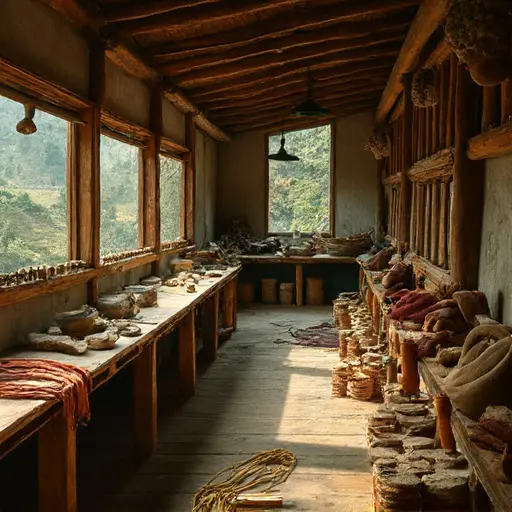
Mara built the room around what she called the Needle Drawer.
It slid from beneath the central table and contained balancing sketches, pilgrimage notes, and scraps from older commissions she refused to discard.
The drawer is still there.
Half open.
Inside rests a ribbon unlike the others—deep crimson, unfinished at one end, weighted with tiny hammered beads that were never sewn fully into place.
Mara had once traveled frequently between villages carrying wrapped bundles and measuring cords tied around her waist. She became known not for conversation but for observation. Organizers often asked her to stand quietly near open courtyards and simply watch how wind moved through fabric before making recommendations.
For years there was enough work.
Then pilgrimage culture changed.
Package tourism and event contractors transformed many traditional gatherings into scheduled attractions with standardized decorations purchased in bulk. Handmade balancing gave way to uniform imports and disposable materials assembled quickly for crowds.
Mara tried adapting.
She repaired factory ribbons.
Adjusted them.
But she disliked how temporary everything had become.
The real damage arrived later.
A series of lands disputes divided surrounding communities and interrupted several historic procession routes entirely. Gatherings shrank. Some disappeared. Without the journeys, the ribbons lost their purpose.
Mara withdrew after that.
Neighbors still saw her tending herbs or airing fabrics from the studio windows, but she traveled less and spoke even less.
One winter brought weeks of severe cold and isolation after rockfall damaged access roads through the hills.
Mara, already living with untreated circulation illness, remained inside the house alone.
She passed away before assistance reached the area.
The funeral was modest.
The studio was closed afterward but never dismantled.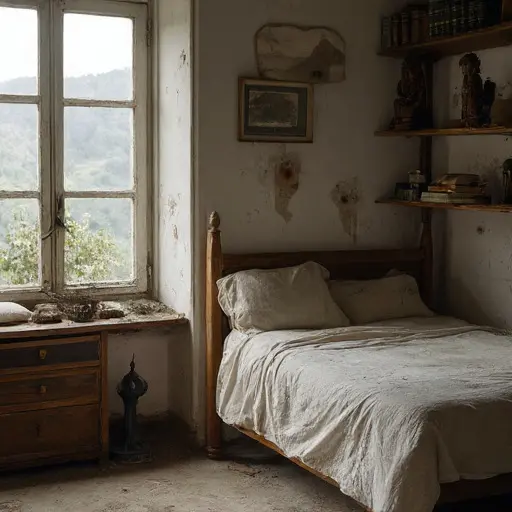
Years later, the house carries an unusual stillness.
The dye stains remain along the table.
The beads still rest in shallow bowls.
And beneath the central workbench, the Needle Drawer continues waiting with Mara’s unfinished ribbon—balanced carefully for a procession that never came.