The Barren House Behind the Fig Orchard Where Nadim’s Weather Flags Never Came Down
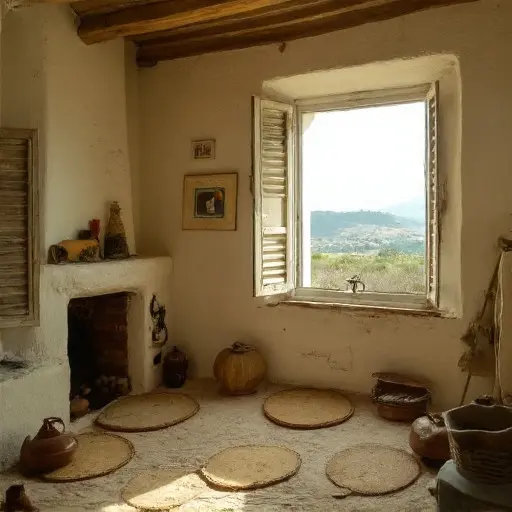
The flags were not outside.
That confused people.
They expected poles and rooftops.
Instead, dozens of fabric triangles hung indoors from rafters and wall hooks—stitched in different weights, colors, and shapes, each carrying faint dust and careful handwritten markings.
The house belonged to Nadim Farouk.
He lived there alone and worked in a profession that once mattered to people who depended on sky more than schedules.
Nadim was a seasonal wind flag calibrator.
His work involved designing and balancing fabric weather flags used by orchard farmers, irrigation cooperatives, and desert-edge growers to read subtle directional shifts affecting frost, dust movement, and pollination.
He did not forecast weather.
He taught cloth how to speak.
The upper room still holds that language.
Spools of linen thread rest beside balance scales. Dye bowls sit beneath shelves stained by years of pigment testing. Pattern measurements remain sketched across long strips of paper weighted with smooth river stones.
The Sirocco Frame Landing
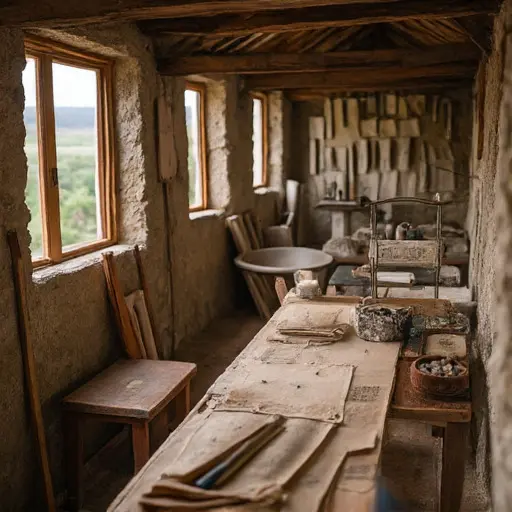
Nadim preferred working near the Sirocco Frame Landing.
The narrow platform overlooked orchard rows and allowed him to observe airflow before trimming or weighting new designs.
One unfinished flag still hangs there.
Its border stitched.
Its balancing tassels missing.
Nadim inherited neither house nor profession.
He learned from traveling growers and eventually became the person nearby farmers sought before planting seasons or difficult harvest years.
For decades the work survived.
Flags helped interpret microclimates long before satellite forecasts reached smaller agricultural communities.
Then agriculture industrialized.
Large agribusiness systems, automated monitoring tools, and centralized weather services steadily replaced localized knowledge and handmade forecasting tools. Small orchards consolidated or disappeared.
Nadim adapted badly.
He distrusted remote forecasts and continued calibrating flags even after orders became rare.
Then the aquifers dropped.
Over-extraction and prolonged drought weakened irrigation networks throughout the surrounding region, shrinking orchards and forcing many growers to abandon cultivation entirely.
The orchard below his house slowly thinned.
So did his work.
Already struggling with untreated kidney illness and increasing isolation, Nadim spent longer days upstairs watching wind patterns nobody requested anymore.
One afternoon during extreme heat, he suffered a fatal collapse beside the landing.
The funeral brought farmers who still remembered reading his flags before storms.
The house remained afterward.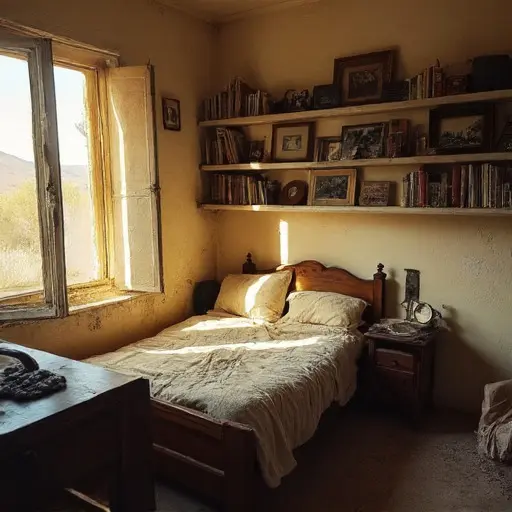
The scales remain beside the thread.
The pattern papers still lie beneath their stones.
And above the Sirocco Frame Landing, Nadim’s unfinished weather flag continues hanging in the same unmoving air he spent a lifetime trying to understand.