The Forsaken House Beyond the Date Palms Where Samira’s Sky Cloth Still Hangs
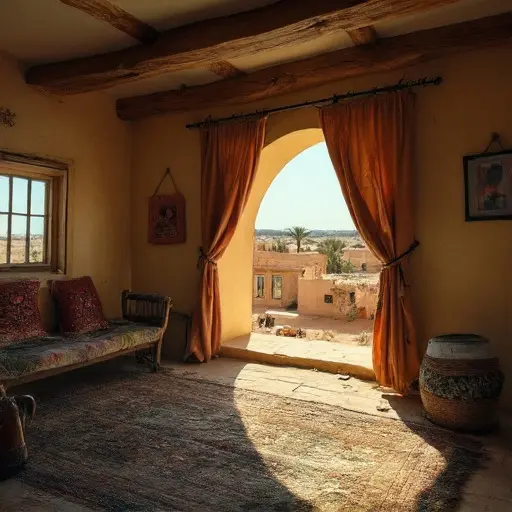
The fabric should have fallen years ago.
That is what people say.
Yet even after storms and heat, one length of cloth still hangs beneath the beams of the rear room, unmoving except for desert wind slipping through the courtyard.
The house belonged to Samira El-Amin.
She lived there alone and worked in a profession that disappeared so quietly few people noticed it leaving.
Samira was a celestial canopy stitcher.
Her work involved sewing large ceremonial fabrics suspended above wedding courtyards and seasonal gatherings—cloth ceilings stitched with stars, geometric constellations, and symbolic skies designed to cool spaces and transform open air into something almost sacred.
She did not weave the material.
She composed the heavens that rested above people.
The rear room of the house still carries traces of that work.
Bundles of dyed thread remain inside cedar boxes. Measuring cords hang from hooks near the ceiling. Needle cushions and folded sketches rest beside brass lamps darkened by dust.
The Constellation Beam
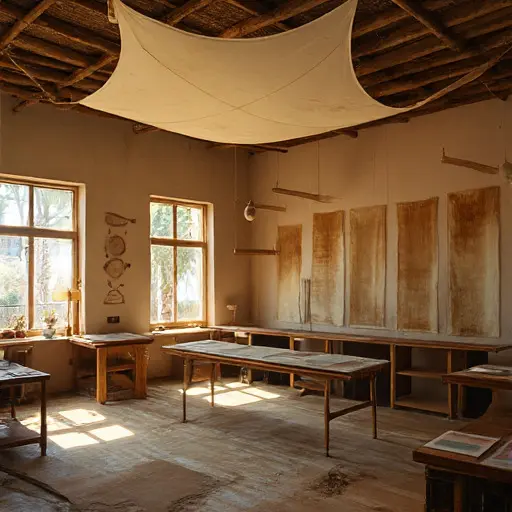
Samira worked beneath what she called the Constellation Beam.
It crossed the highest part of the ceiling where she suspended larger fabrics while aligning star patterns and seam tension.
One unfinished canopy still hangs there now.
Its border completed.
Its central sky unfinished.
Samira never left the district where she was born.
After her parents died, the house became quieter but remained busy during festival seasons when courtyards filled and commissions arrived steadily.
For decades, families sought her work.
Then celebrations changed.
Commercial event rentals and imported decorative tents replaced much of the handmade canopy tradition. Ready-made fabrics arrived cheaper and faster than any artisan could compete with. Younger families favored convenience over custom symbolism.
Samira accepted fewer commissions but continued sewing.
Not for business.
For continuity.
Then the wells began to fail.
Years of groundwater depletion altered daily life throughout nearby settlements. Gardens dried. Migration increased. The district emptied slowly and public services weakened alongside it.
Samira developed chronic illness during those years but resisted leaving the house.
One summer, weakened by dehydration and worsening kidney complications, she passed away quietly before relatives could reach her.
Her funeral took place beneath rented shade.
The irony did not go unnoticed.
The courtyard remains silent now.
The thread boxes still rest beneath the shelves.
The sketches remain folded beside the lamp.
And above the Constellation Beam, Samira’s unfinished sky cloth continues to hang exactly where she left the stars unfinished.