The Hollow House on Lantern Street Where Karim Never Finished the Ceiling

People still mention the ceiling.
Not because it collapsed.
Because it never did.
One corner above the central room remained unfinished for years—bare timber exposed between painted beams, waiting for work that somehow never resumed.
The house belonged to Karim Haddou.
He lived there alone after losing his wife and spent most of his life working as a plaster rosette mold cutter.
Karim produced decorative molds used to shape ornamental ceiling medallions and wall details for older homes, prayer halls, and restoration crews.
The work demanded precision and patience.
He carved negative forms from wood and hardened compounds, then sold or rented them to craftsmen repairing historical interiors.
The house reflected the profession quietly.
Ceiling fragments leaned against walls. Measuring strings crossed shelves. Powdered plaster gathered beneath worktables and settled into corners impossible to fully clean.
His workshop occupied what had once been the family receiving room.
The Gypsum Lantern Niche
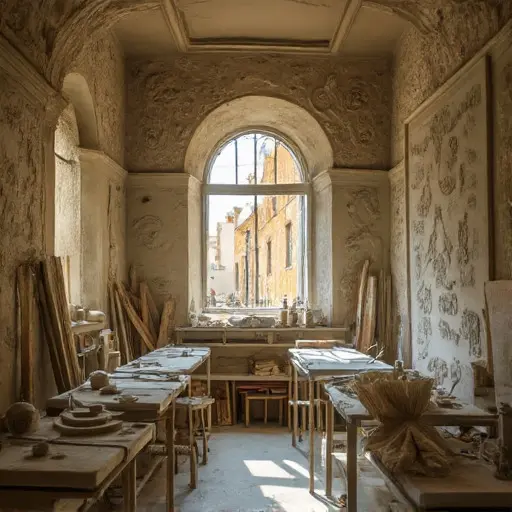
Karim worked closest to the Gypsum Lantern Niche.
The alcove sat beneath a hanging brass lantern and held his most trusted templates—delicate floral patterns wrapped in cloth beside older commission books.
One unfinished rosette remained there.
Half carved.
Waiting.
For years Karim found enough work restoring aging interiors across the district.
Then the city changed.
Modern construction favored simpler finishes and prefabricated interiors. Historic restorations slowed. Developers demolished many buildings that once required artisans like him. Decorative plaster survived mostly in photographs or luxury commissions few locals could afford.
Karim adapted poorly.
He accepted smaller repairs and spent longer periods inside the house.
Yet he never stopped working on ceilings.
Neighbors remembered hearing carving sounds late at night and smelling damp plaster drifting through the courtyard after rain.
Then came the sinkholes.
A period of underground drainage failures destabilized several older streets nearby. Cracks appeared across walls and alleyways. Temporary closures spread through the quarter while repairs stalled.
Karim ignored most warnings.
One evening, while inspecting structural damage inside a partially abandoned building where he had been hired to assess ceiling ornamentation, a weakened interior floor gave way beneath him.
He died from the injuries days later.
The funeral passed quietly.
His nephews collected legal papers but left almost everything else untouched.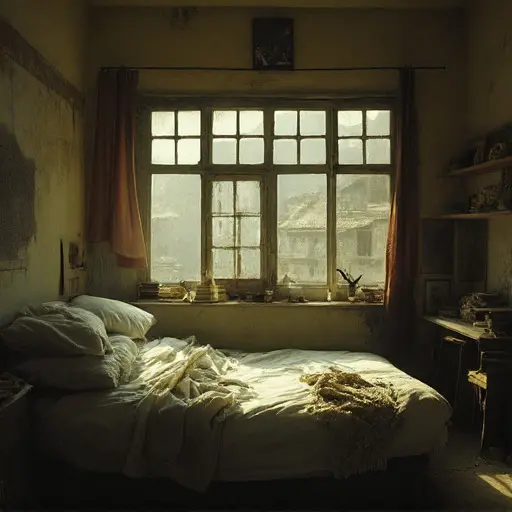
Now the house waits behind its weathered door.
The lantern still hangs.
The plaster dust still gathers beneath the shelves.
And above the Gypsum Lantern Niche, Karim’s unfinished ceiling remains exactly as he left it—one corner forever waiting to be completed.