The Hidden Ledger of Montague’s Apothecary
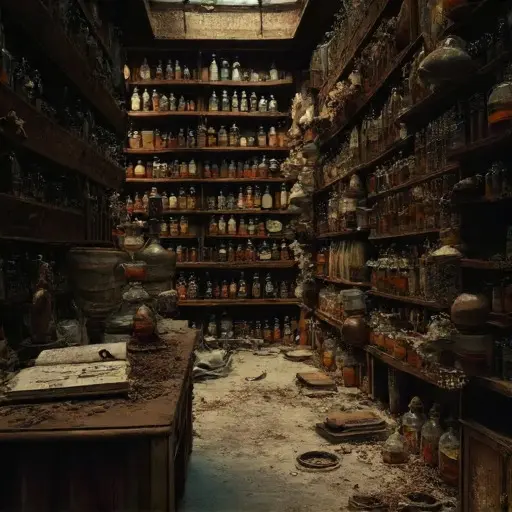
The apothecary is frozen mid-task, its tools and vessels poised as if someone had stepped away for a moment and never returned. The ledger records customer remedies, ingredients, and dates, halted mid-entry. Mortars are scattered, bottles half-filled, measuring spoons lying in irregular patterns.
Silence dominates, heavy with absence, as though the room itself remembers the last visitor.
Remedies Left Unfinished
This space belonged to Clara Montague, apothecary and herbalist (b. 1873, Edinburgh), who catered to a modest clientele with remedies both common and rare. Evidence of her life is scattered: a folded note from her brother James Montague warning of illness spreading through the district; a pressed flower pinned to a ledger page; gloves stiffened with powder; a small satchel of dried herbs. Her life was methodical—early cataloging, precise measurements, and careful labeling. Knowledge was her constant companion, yet the weight of clientele and illness grew too great over time.
Signs of Abrupt Decline
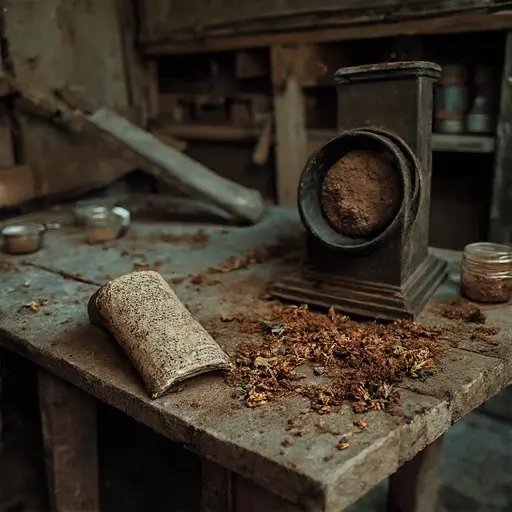
Clara’s decline resulted from overwork and worsening eyesight. Entries in the ledger show repeated corrections, smudged notations, and skipped calculations. Some jars are mislabeled, others untouched. A tincture sits half-prepared on the counter. A towel is folded roughly on a shelf, a mortar tipped over. Each surface records meticulous effort stopped suddenly. Anxiety and exhaustion are implied in the uneven arrangement of tools, in the hurried crossing-out of remedies.
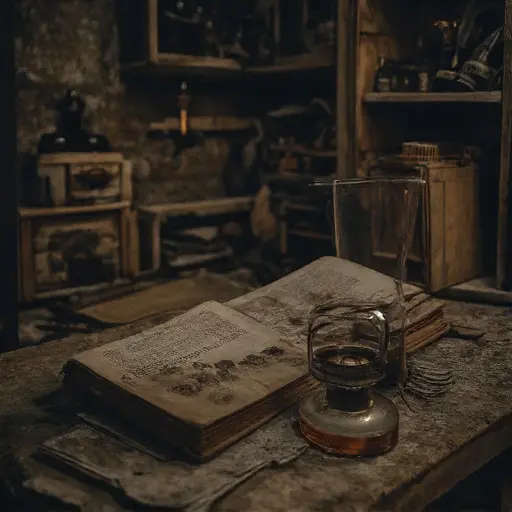
The ledger remains open, entries incomplete, remedies unprepared, and calculations unresolved.
No apprentice continued her work. No note explains Clara’s sudden disappearance.
The apothecary remains abandoned, its shelves, bottles, and ledger a quiet testament to interrupted diligence, sudden absence, and a mystery that lingers among the dried herbs and faint traces of oil and ink.