UNSETTLING Silence on the Dead Frequency
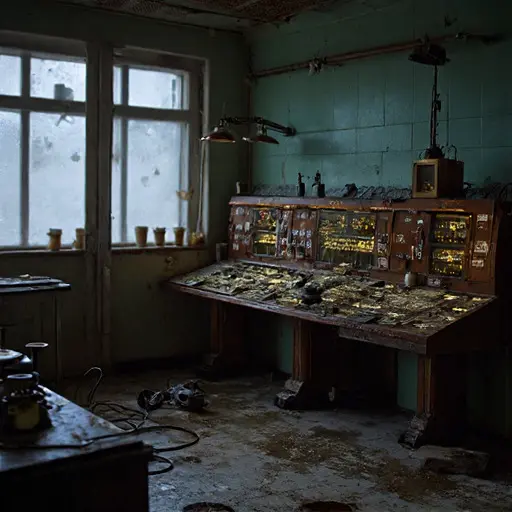
The radio console hums without power, a remembered vibration rather than a real one. Its needles are locked at odd angles, as if stopped mid-breath. Chairs are pulled close, not tucked in.
Someone was listening carefully here, leaning forward, afraid to miss a word.
This room once belonged to Yuri Sokolov, a long-distance radio operator assigned to monitor emergency bands and weather relays. His work was solitary and exacting, conducted during long winter nights. The shelves hold Cyrillic-labeled manuals, signal logs bound with twine, and folded maps marked with pencil circles far north of any city. A wool coat hangs by the door, heavy with frost that never melted.
Signals That Should Not Repeat
Yuri’s notebooks reveal a change in handwriting over time. Early entries are neat and procedural: timestamps, frequencies, atmospheric notes. Later pages tighten, letters crowding each other. One phrase appears again and again in the margins—dead frequency—underlined, boxed, then scratched out. The radio console bears small adhesive markers placed and removed repeatedly, their residue clouding the metal.
On the desk, a tuning fork rests beside a half-written message. The message stops mid-sentence. The pen was not dropped; it was set down deliberately.
Static With Intent
Neighbors recalled Yuri complaining about a signal that returned every night at the same minute. Not a broadcast, not interference—something structured, repeating. He adjusted the radio console endlessly, convinced the source was moving closer. Official logs show no anomalies. His private notes suggest otherwise: sequences of numbers that do not match known codes, pauses described as “listening back.”
The samovar was filled that evening but never lit. Two mugs were placed out, though Yuri lived alone.
The Room Afterward
When authorities entered the communications room weeks later, the radio console was still set to the same frequency. Power had long been cut, yet the dials were warm to the touch. Headphones showed signs of wear on only one side, as if he listened with a single ear, keeping the other tuned to the room. The microphone carried no recorded transmissions from that night—only a brief burst of breath, followed by silence.
No signs of struggle were found. No footprints led away from the building despite fresh snow outside. Yuri’s coat remained on its hook. His boots were still under the desk.
What Remains Unanswered
The decline was not madness in the ordinary sense, but fixation. Yuri stopped trusting official channels, believing the dead frequency was meant only for him. His final log entry reads: “It knows when I am listening.” After that, the pages are blank.
The radio console has never been retuned. Technicians refuse to power it on again. At night, the building settles and contracts, and the empty room seems to lean inward, as though still waiting for a signal to finish what it started.
No disappearance notice was ever resolved.
The frequency remains unassigned.
And the silence, according to those who stand near the console long enough, does not feel empty at all.