The Lost Survey Cabinet of Nakamura’s Mapping Room
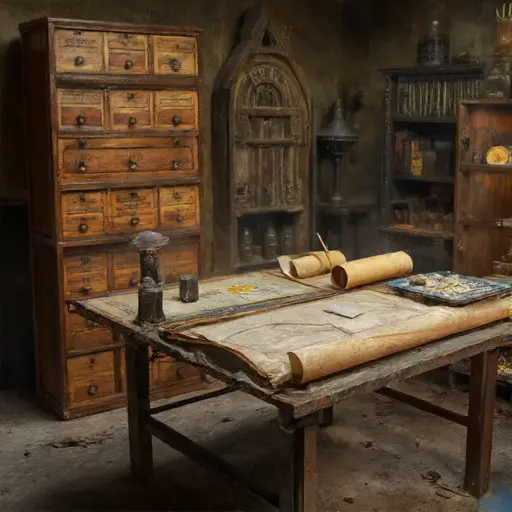
The Mapping Room is hushed, disciplined, and inward. From the first glance, the word survey asserts itself through halted routines: drawers left ajar, tools aligned, maps weighted but unfinished. Nothing appears rushed.
The interruption feels deliberate, as though precision itself demanded a pause that never resolved. The quiet is heavy with intent, suggesting the presence of careful hands gone without explanation.
Discipline of the Survey
The room belonged to Hiroshi Nakamura, cartographer (b. 1873, Kanazawa), trained through technical institutes serving civil administration. His education appears in precise gridlines, kanji annotations, and carefully measured scale bars. A folded note names his brother, Masao Nakamura, requesting corrected elevations. Hiroshi’s temperament was restrained and exacting; ambition lay not in fame, but in accuracy trusted by unseen officials and engineers. Each line and symbol in the room speaks to repeated routines practiced with relentless care.
Cabinets That Held the Land
Each drawer contains sheets numbered and cross-referenced. Coastal contours, river gradients, and urban blocks repeat with incremental revisions. One drawer holds a single survey sheet separated from its set, corners worn thin from repeated checking. On the drafting table, a compass rests open, its needle fixed, as if measurement itself refused to proceed. Ink stains circle lines and margins; each imperfection is evidence of diligence, now frozen in time.
Discrepancies Without Resolution
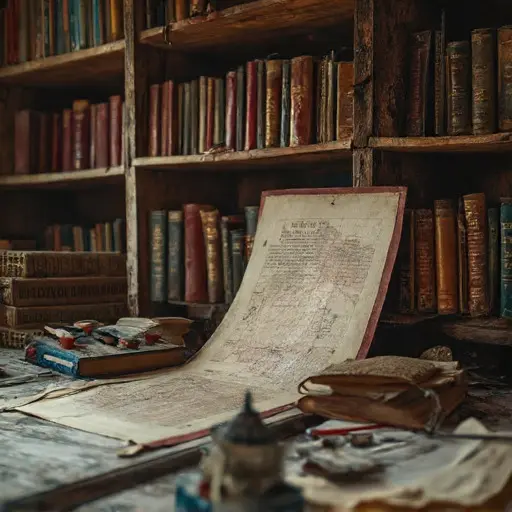
Ledger margins show recalculated figures, some circled twice. Heights are adjusted downward, then restored. No explanation is written. Several sheets are marked “withhold.” Hiroshi’s handwriting grows smaller, tighter. The decline is administrative rather than physical: pressure from conflicting data, responsibility without authority, corrections that could not satisfy competing demands. Accuracy became liability, each day’s work postponed, decisions deferred, the weight of unresolved surveys quietly suffocating his methodical pace.
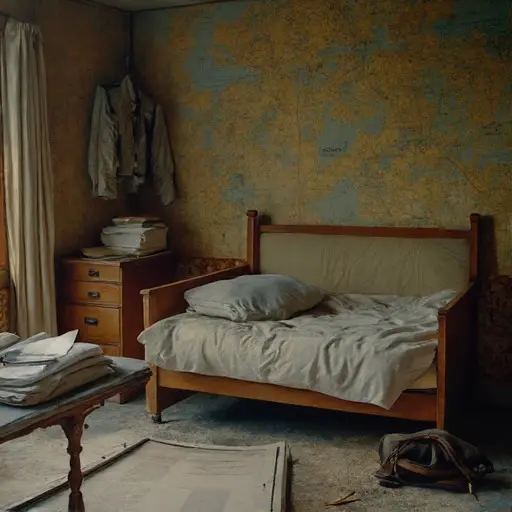
The final drawer of the cabinet contains one incomplete survey, unsigned and half-inked.
No dismissal notice remains. No reassignment is recorded. No one returned to continue his meticulous work.
The house remains abandoned, its maps unresolved, its measures suspended, its careful order slowly yielding to silence, dust, and the lingering scent of ink and rice paste.