The Hidden Draft Boards of the Kovács Architectural Studio
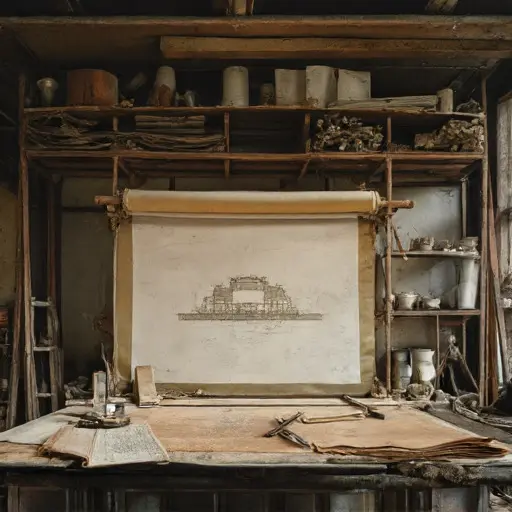
A quiet precision fills the Studio, where compasses remain poised, and vellum sheets are pinned but untouched. Every tool and sheet conveys a meticulous rhythm suddenly interrupted, leaving work suspended in mid-motion.
The Architect’s Method
These tools belonged to Géza Kovács, architect (b.
1878, Budapest), trained at a local atelier and commissioned for private residences and civic buildings. His Hungarian annotations note wall thickness, column spacing, and arch proportions. A folded slip references his apprentice, Eszter Kovács, “prepare façade sketches Thursday,” showing a disciplined, structured workflow of measuring, drafting, and annotating executed with exacting care.
Arrangement of Instruments and Plans
On the drafting table, rulers, compasses, and T-squares are aligned by size; pencils lie sharpened beside ink bottles. Rolled plans stand stacked by project. A partially drafted building façade rests weighted under a wooden block, reflecting Géza’s suspended process. Dust settles into every crease, preserving the faint impression of hands moving along precise lines.
Signs of Interruption
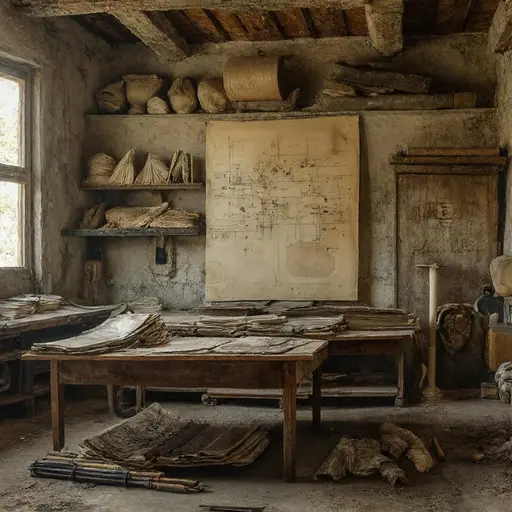
Later ledger entries reveal uneven progress; some façade plans are incomplete, proportions slightly off. Margin notes—“client requested revision”—are smudged. Drafting tools are misaligned, ink bottles dried, and vellum sheets curled. Géza’s precision faltered under worsening eyesight and mounting professional stress, leaving projects unfinished and studio routines suspended indefinitely.
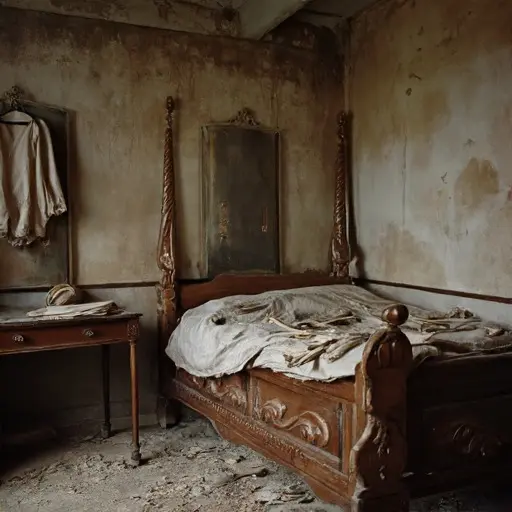
In the Studio’s final drawer, Géza’s last draft ends mid-line, annotations incomplete, façades unfinished. A penciled instruction—“review with Eszter”—cuts off abruptly.
No record explains why he abandoned his work, nor why Eszter never returned.
The house remains abandoned, its drafting tables, vellum sheets, and draft plans a quiet testament to interrupted design and unresolved architectural devotion.