The Haunting Cabinet of Lindström’s Forgotten Apothecary
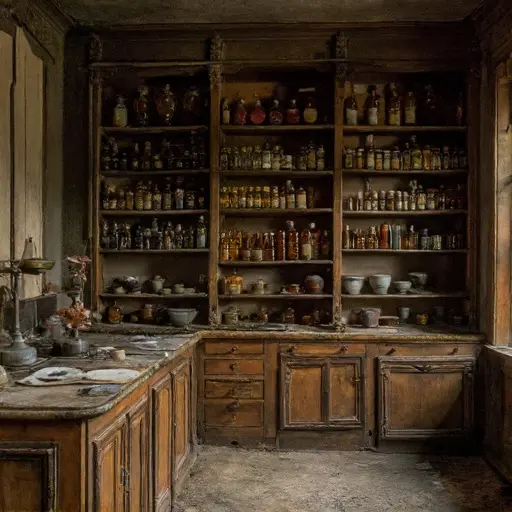
The apothecary remains in deliberate stillness. On the marble counter, a mortar contains powdered bark left unblended, its compound formula unfinished. Tools and glassware are placed carefully, suggesting work interrupted with care, not by haste or calamity.
The room hums with absence, every object a marker of halted habit.
Formulas Crafted by Precision
This space belonged to Karin Lindström, professional apothecary (b. 1870, Uppsala), trained in university and municipal dispensaries. Her handwriting appears on jars and labels, neat and restrained. A note references her cousin, Erik Lindström, who delivered ingredients each morning. Her days followed strict order: measuring, grinding, blending, and recording compound formulas with methodical care. Temperament exact, ambition restrained, and a quiet insistence on correctness defined her work. Her life revolved around a precise cadence, interrupted only by city inspections or rare orders from local physicians.
Shelves That Remained Undisturbed
Glass jars and paper packets rest untouched. A ledger lists ingredients, quantities, and compound ratios but ends mid-page. A cabinet door hangs slightly open, revealing powders sorted but never dispensed. Dust gathers over uncut herbs, tools, and a brass pestle, showing where activity ceased. Every object conveys intention and preparation, but no completion. A small wooden stool remains tucked under the counter, suggesting she might have returned any moment to resume her careful labor.
When Craft Became Obsolete
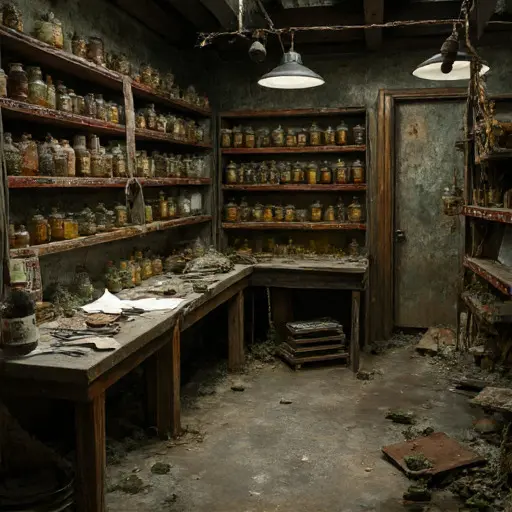
Later ledger entries grow sparse. Correspondence with suppliers and municipal inspectors remains unopened. Lindström’s decline was not personal but institutional: new regulations mandated pre-mixed remedies from state suppliers, making her careful hand-prepared compound formulas redundant. Her daily work slowed, then ceased, without overt conflict. The room’s quiet efficiency became a relic of a disappearing craft, the precision no longer valued in modern policy.
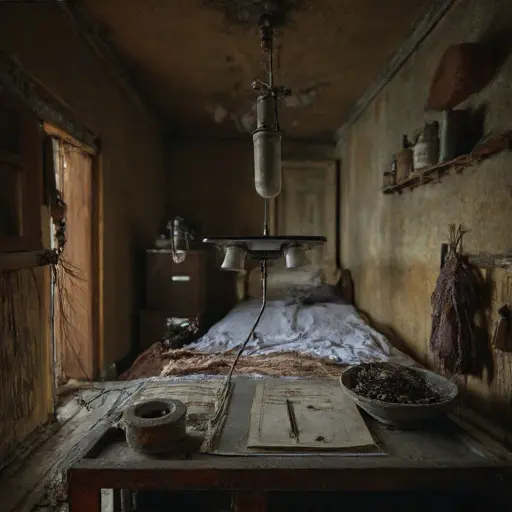
The final ledger and jars remain untouched. No note explains Lindström’s departure; Erik never returned to collect them. The house remains abandoned, cabinets full, scales balanced, each compound suspended in quiet expectation, a craft paused indefinitely by forces outside the room itself, the stillness itself becoming its own haunting testament to labor left unfinished.