The Silent Loom of the Al-Hakim Weaver’s Chamber

A deep, expectant quiet fills the Weaver’s Chamber, where penciled warp notations on a design sheet cease abruptly, signaling interrupted creation.
Discipline in Thread
These implements belonged to Layla Al-Hakim, weaver (b. 1883, Cairo), trained in a local guild of textile artisans.
Her Arabic notes record warp counts, thread tension, and color sequences. A folded slip references her apprentice, Sami Al-Hakim, “complete patterned strip Wednesday,” revealing a daily regimen of setting looms, dyeing threads, and weaving, alongside a temperament of patience, methodical rhythm, and unwavering precision.
Looms and Spools
On the main loom, threads of silk and cotton lie taut, mid-pattern. Shuttles rest on side benches, dusted yet meticulously placed. A ledger beneath a cloth records thread types, dye ratios, and length calculations, each carefully dated. A partially woven panel remains pinned, evidence of interrupted labor, frozen in careful progress yet unfinished.
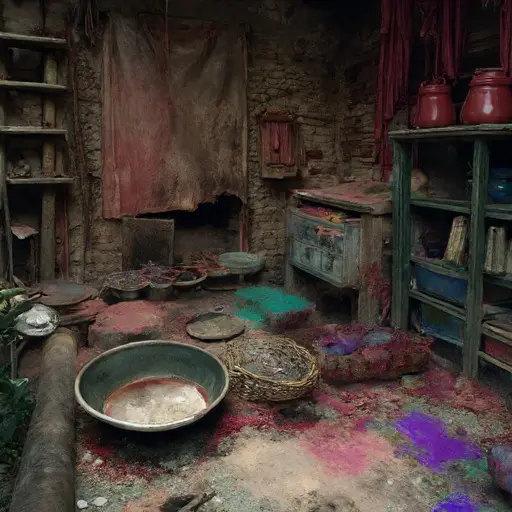
Faltering Precision
Later ledger pages reveal repeated corrections to warp alignment and color gradients. Several textile panels exhibit uneven weave tension or misaligned motifs. A margin note—“client rejects shade”—is smudged, indicating mounting stress. Shuttles and spindles lie abandoned across benches. Chronic fatigue and joint pain forced Layla’s meticulous hand to falter, leaving weaving unfinished and her careful routines permanently disrupted.
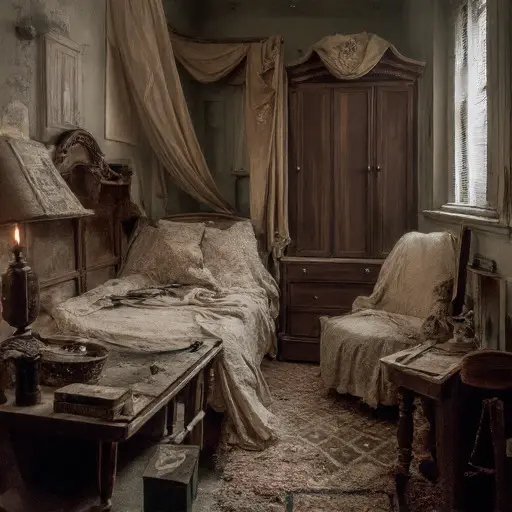
In the Chamber’s final drawer, Layla’s last warp sheet ends mid-notation, instructions trailing into blank space. A penciled note—“check with Sami”—stops abruptly.
No evidence explains why she abandoned her work, nor why Sami never returned to finish the fabrics.
The house remains abandoned, looms and textiles frozen mid-creation, preserving the quiet persistence of weaving interrupted, unresolved, and suspended in hushed neglect, a testament to meticulous craft left unfinished.