The Eerie Ledger of the Al-Masri Calligrapher’s Alcove

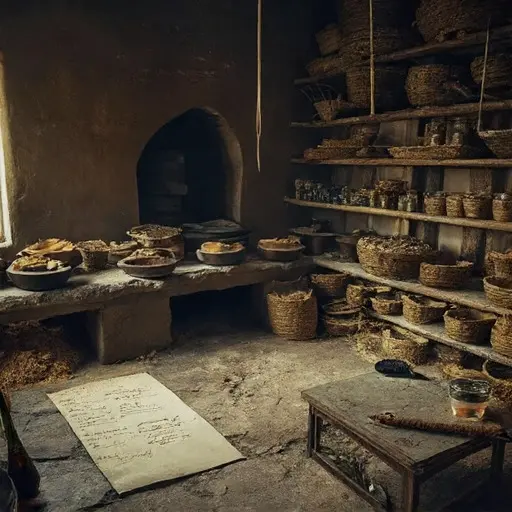
A quiet, expectant stillness fills the Calligrapher’s Alcove, where a penciled stroke annotation on a manuscript halts abruptly, hinting at artistry left unfinished.
Discipline in Form
These implements belonged to Yusuf Al-Masri, calligrapher (b. 1876, Cairo), trained under a local master in fine Arabic scripts.
His notes, flowing and precise, record ink viscosity, nib angle, and stroke order. A folded slip references his nephew, Karim Al-Masri, “complete qasidah folio Thursday,” revealing a routine of daily practice, manuscript preparation, and careful mentoring, underscored by an exacting temperament and patient methodology.
Pens and Parchment
On the main table, reed pens are aligned beside ink stones and smudged blotters. Manuscripts lie half-open, their gilded edges catching faint dust. A ledger beneath folded cloth details stroke sequences, letter forms, and page counts, each meticulously dated. A partially scribed folio rests ready for completion, the black ink still crisp but untouched, a frozen testimony of interrupted work.
Decline in Precision
Later ledger pages reveal corrections to nib angles and letter spacing. Several manuscript lines show uneven pressure or slightly smeared ink. A margin note—“client dissatisfied with diacritic spacing”—is smudged, suggesting mounting anxiety. Pens lie scattered across the desk, some broken. Yusuf’s failing eyesight and trembling hand forced the careful routines of calligraphy to falter, leaving the alcove in suspended productivity, unfinished and paused.

In the Alcove’s final drawer, Yusuf’s last stroke sheet trails off mid-line, annotations unfinished. A penciled note—“confirm with Karim”—breaks off abruptly.
No evidence explains why he ceased work, nor why Karim never returned to finish the manuscripts.
The house remains abandoned, pens and parchment frozen mid-creation, preserving the delicate persistence of calligraphy interrupted, silent, unresolved, and suspended in the quiet weight of abandoned artistry.