The Eerie Manuscripts of the Haldane Cartographer’s Study
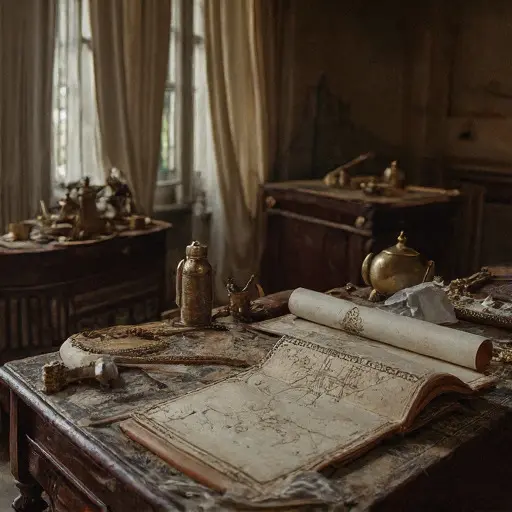
The Study hums with silent coordinates. On the desk, penciled manuscript notes trail off abruptly. Every compass, ruler, and map embodies meticulous labor abruptly paused, the rhythm of cartography suspended in quiet stillness.
The once orderly space now whispers absence through curled map edges and toppled inkpots.
Life Among Maps and Bearings
These implements belonged to Fergus Haldane, cartographer (b. 1876, Edinburgh), trained at the Royal Scottish Academy of Geography, skilled in topographical surveys and maritime charting. Manuscripts record mapped coastlines, inland rivers, and letters to surveying colleagues. A folded note references his apprentice, Alastair Haldane, “plot contour lines Thursday,” revealing disciplined routines of drafting, measuring, and annotating executed daily with meticulous care. Journals hint at obsessive precision, encroaching cataracts, and tremors affecting fine line work. His temperament was methodical, reserved, yet quietly anxious about the growing pressure of commissioned maps for expanding trade routes.
Tools of Survey and Drafting
Desks hold half-completed charts, scattered ink quills, and brass dividers. Rolled maps lie stacked, some curling. Fergus’s manuscripts, weighed down by a brass compass, detail elevations, coastline coordinates, and survey notes. Dust settling over implements emphasizes abrupt cessation of repeated, precise gestures, silence accentuated by unfinished charts and displaced instruments. The manuscript is the focus, revealing intricate work interrupted mid-measurement, pencil lines frozen in tentative arcs that will never be completed.
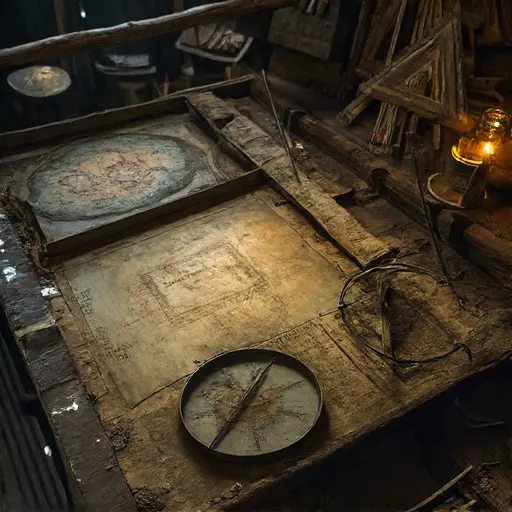
Signs of Fading Precision
Later manuscript entries reveal misaligned grid lines and repeated corrections. Margin notes—“Alastair questions bearing accuracy”—are smudged. Rulers chipped, ink thickened, paper curling. Fergus’s tremors subtly distort plotting. Pencil notations trail off mid-line, quietly recording declining skill and unfinished maps. Minor ink smudges mark desk edges, evidence of mounting frustration and faltering accuracy. Letters to trade clients remain sealed, unopened, revealing the external pressures that drove him into isolation and eventual disappearance.
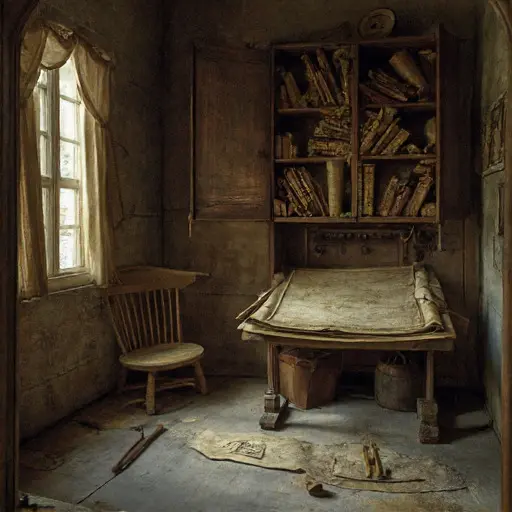
In the Study’s final drawer, Fergus’s last manuscript ends mid-coordinate, a penciled note—“verify with Alastair”—abruptly stopping.
No record explains why he abandoned his work, nor why Alastair never returned.
The house remains abandoned, manuscripts, compasses, and maps awaiting hands that will not return, the quiet heavy with unfinished exploration and lost mastery.