The Forgotten Drafts of the Kovács Composer’s Music Room
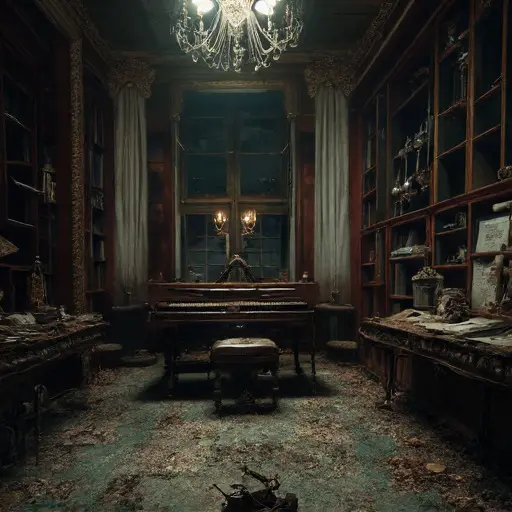
The Music Room hums with silent harmonies. On the piano, penciled draft notes trail off abruptly. Every quill, metronome, and score embodies meticulous labor abruptly paused, the rhythm of composition suspended in quiet stillness.
Life Among Keys and Notation
These implements belonged to Márton Kovács, composer (b. 1885, Budapest), trained at the Royal Academy of Music and skilled in both chamber music and orchestral arrangements. Ledger entries document commissioned pieces for private salons and local theaters. A folded note references his apprentice, László Kovács, “complete cello part Thursday,” revealing disciplined routines of drafting, revising, and performing executed daily with meticulous care. Journals hint at obsessive attention to harmony, mounting insomnia, and progressive hearing loss affecting precise notation.
Instruments of Composition
Desks and piano surfaces hold half-written scores and scattered tools. Quills, ink pots, metronomes, and notebooks lie stiff with dust. Shelves of completed and unfinished scores rest nearby. Márton’s ledger, weighed down by a bronze inkwell, details musical phrases, tempo markings, and orchestration notes. Dust settling over implements emphasizes abrupt cessation of repeated, precise gestures, silence accentuated by half-completed compositions and displaced instruments.
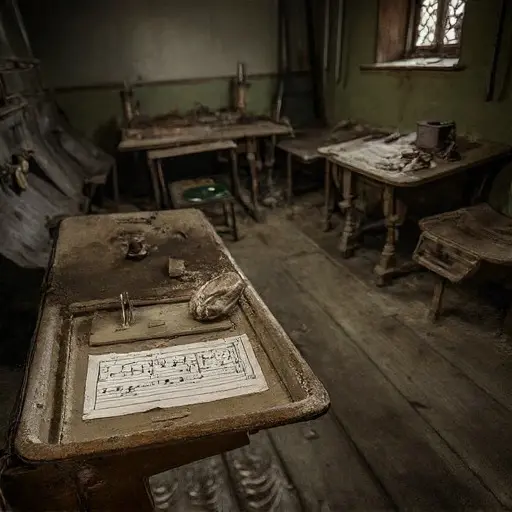
Signs of Waning Precision
Later ledger entries reveal skewed draft lines and repeated corrections. Margin notes—“László questions violin phrasing”—are smudged. Quills worn, ink thickened, staves wrinkled. Márton’s tremors and hearing loss subtly distort notation. Pencil notations trail off mid-bar, quietly recording declining skill and unfinished scores. Minor ink stains mark edges of music sheets, evidence of mounting frustration and faltering creativity.
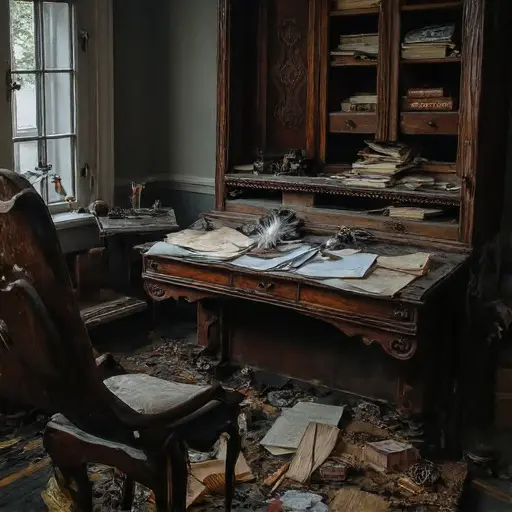
In the Music Room’s final drawer, Márton’s last draft ends mid-composition, a penciled note—“verify with László”—abruptly stopping.
No record explains why he abandoned his work, nor why László never returned.
The house remains abandoned, drafts, quills, and scores awaiting hands that will not return, the quiet heavy with unfinished artistry and lost mastery.