The Eerie Charts of the Hassan Astronomer’s Observatory
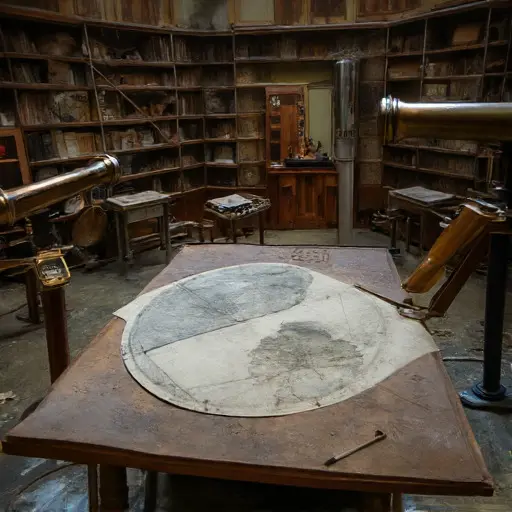
The Astronomer’s Observatory resonates with suspended stillness. On a table, penciled declination notations for a lunar map trail off unfinished. Every chart, instrument, and notebook embodies exacting observation abruptly paused, the careful rhythm of measurement frozen in quiet anticipation.
Life Among the Stars
These tools belonged to Zainab Hassan, astronomer (b. 1878, Cairo), trained in Egyptian observatories and familiar with both Ptolemaic and modern celestial mapping. Ledger entries document commissioned maps for local scholars and mosque clock towers. A folded note references her assistant, Karim Hassan, “deliver longitude charts Friday,” showing a disciplined pattern of observation, recording, and drafting executed daily with precise care.
Instruments and Measurement
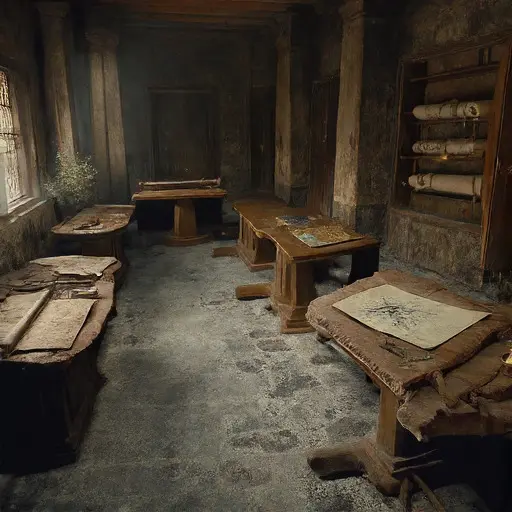
Telescopes are aimed at paused angles. Compasses, protractors, and ink brushes lie scattered. Star charts and notebooks cover drafting tables. Zainab’s ledger, weighed down by a brass ruler, details celestial coordinates, observation times, and target stars. Dust over charts and instruments highlights abrupt cessation of repeated, meticulous actions.
Evidence of Waning Focus
Later ledger entries reveal inconsistent declination markings and corrections repeated multiple times. Margin notes—“Karim questions angular accuracy”—are smudged. Compasses show uneven wear, ink brushes brittle. Zainab’s failing eyesight and tremor subtly distort lines. Penciled guides trail off mid-grid, a quiet record of gradual decline in skill and uncompleted celestial mapping.
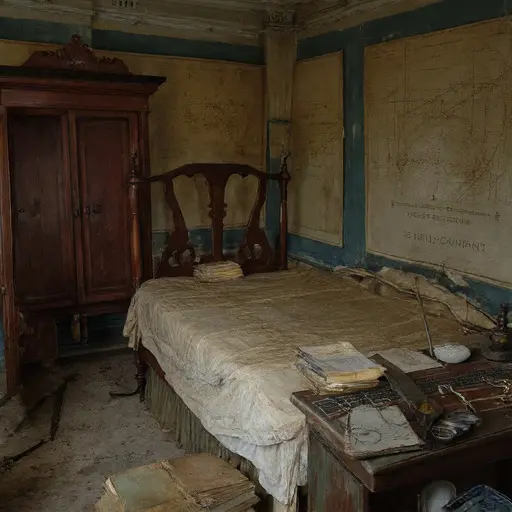
In the Observatory’s final drawer, Zainab’s last chart ends mid-declination, a penciled note—“verify with Karim”—abruptly stopping.
No record explains why she abandoned her work, nor why Karim never returned.
The house remains abandoned, telescopes, charts, and instruments awaiting hands that will not return, the quiet heavy with unfinished study and lost precision.