The Forgotten Scrolls of the Alvarez Cartographer’s Chamber
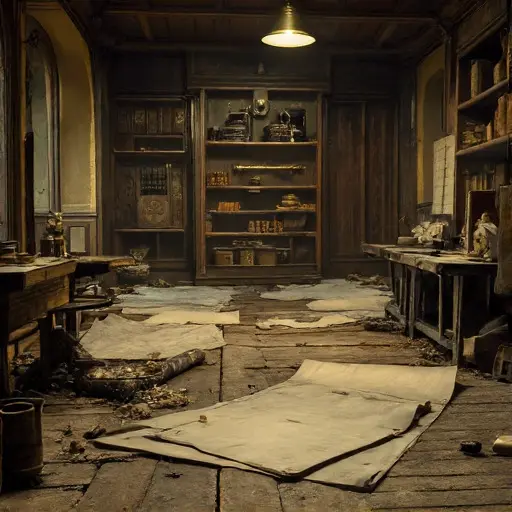
The Cartographer’s Chamber resonates with quiet meticulousness. On a drafting table, penciled contour notations for a regional map stop abruptly. Each map, tool, and instrument embodies precision suspended, a ritual of measurement frozen mid-process.
Life in Lines and Coordinates
These tools belonged to Isabella Alvarez, cartographer (b. 1876, Madrid), trained in Spanish royal map offices and familiar with Mediterranean maritime charts. Ledger entries document commissions from local municipalities and private collectors. A folded note mentions her assistant, Mateo Alvarez, “deliver coastal survey Monday,” reflecting a disciplined pattern of drafting, inking, and verifying measurements.
Instruments of Navigation
Drafting tables are strewn with partially completed maps. Compasses, rulers, and calipers lie scattered beside ink-stained vellum. Quills rest in holders, some stiff with dried ink. Isabella’s ledger, beneath a glass sheet, notes client names, scales, and intended publication. Dust and faint residue from ink and pigments emphasize the abrupt cessation of exacting labor.
Signs of Waning Precision
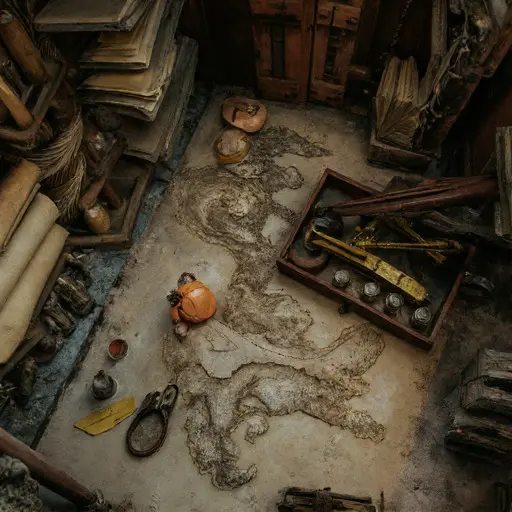
Later ledger entries show uneven contour lines and corrections retraced multiple times. Margin notes—“Mateo questions scale accuracy”—are smudged. Compasses show uneven wear, quills are brittle, and inkpots partially dried. Isabella’s failing eyesight and tremor subtly warp otherwise precise lines. Notations stop mid-instruction, revealing the gradual collapse of her once-confident hand.
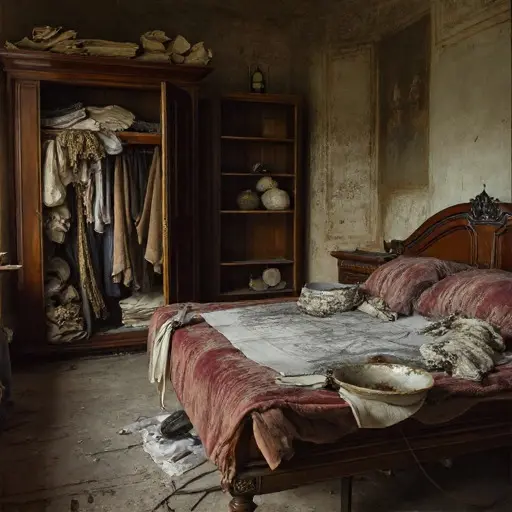
In the Chamber’s final drawer, Isabella’s last map ends mid-contour, a penciled note—“confirm with Mateo”—abruptly cut off.
No documentation clarifies why she abandoned her work, nor why Mateo never returned.
The house remains abandoned, maps, tools, and drafts awaiting hands that will not return, the quiet heavy with unfinished exploration and lost direction.