The Hidden Diagrams of the Bauer Watchmaker’s Atelier

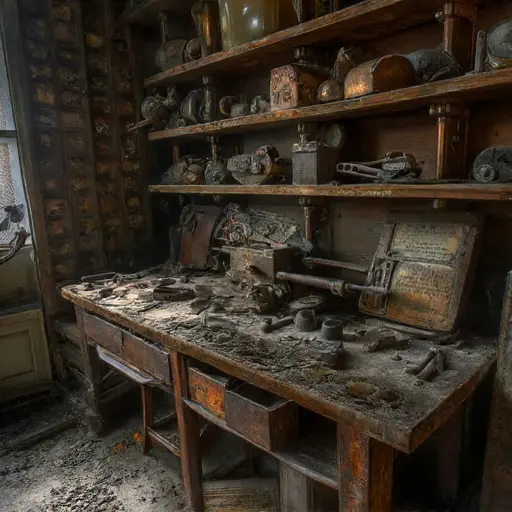
The Watchmaker’s Atelier radiates a suspended quiet. On a brass bench, penciled cog notations for a custom pocket watch stop mid-instruction. Every tool, gear, and spring speaks of a rigorous routine abruptly abandoned, leaving the craft frozen in careful pause.
Life Measured in Time
These implements belonged to Friedrich Bauer, watchmaker (b. 1874, Vienna), trained in the precision workshops of central Europe. Ledger entries record commissions from nobility and merchants. A folded note mentions his apprentice, Heinrich Bauer, “collect components Friday,” reflecting daily routines of disassembly, assembly, and delicate polishing, carried out with meticulous care.
Tools and Precision
Benches display partially assembled watches and loose gears. Screwdrivers and tweezers rest beside trays of pinions and escapements. Oil pots and polishing cloths lie nearby. Friedrich’s ledger, tucked under a glass cover, details client names, completion dates, and watch specifications. Dust covers every object, highlighting the sudden cessation of practiced, repetitive motions.
Evidence of Declining Steadiness
Later ledger entries show misaligned cog arrangements and markings corrected multiple times. Margin notes—“Heinrich questions alignment”—are smudged. Tweezers show uneven wear, screws lie out of place, and gear teeth display slight damage from trembling hands. Friedrich’s failing eyesight and growing fatigue manifest in irregular assembly sequences, penciled guides trailing off into incompleteness.

In the Atelier’s final drawer, Friedrich’s last pocket watch remains half-assembled, cog placements trailing into silence. A penciled note—“verify with Heinrich”—cuts off abruptly.
No record explains why he abandoned his craft, nor why Heinrich never returned.
The house remains abandoned, gears, tools, and half-finished watches waiting in stillness, the quiet heavy with unfinished precision and lost mastery.