The Hidden Berglund Pickling Annex Where the Ratio Turned Wrong
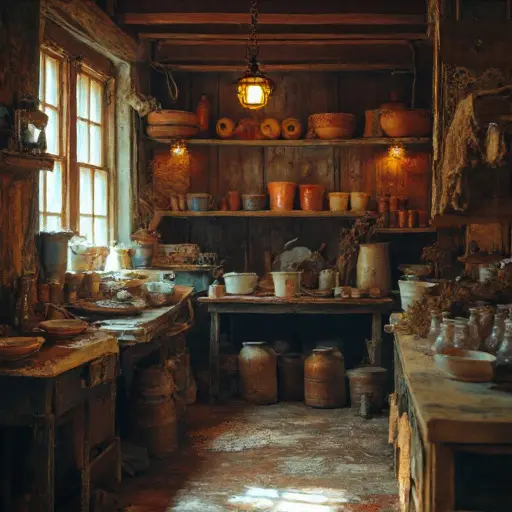
The pickling annex holds the mingled scent of vinegar, clay, and kilnless heat. Light trembles across shelves crowded with bisque-fired bowls, each touched by a color that seems to question itself.
A Glazer Drawn to Calm Proportions
Ingrid Sofia Berglund, born 1878 in Malmö, prepared modest tableware for merchants heading inland.
A linen wrap from her mother Astrid cushions her dipping ladles. Ingrid mixed slips at dawn, tested glazes by midday, and traced subtle accents after dusk. Her simple upbringing lingers in reused crocks, frayed brushes, and Swedish-script slips pressed behind the brine barrels.
Work Teetering on the Edge of Miscalculation
A shallow bowl bears a pale ring where she lightened the glaze mid-stroke. A tin of cobalt oxide sits open, its rim unevenly dusted. The dipping tongs rest crooked against a crock, their tips stained in a muddled gradient. On the counter, a brush lies bristles-up, hardened by interrupted rinsing. Even the lantern’s flame narrows toward the drying rack, shadowing the patchy sheen on waiting vessels.
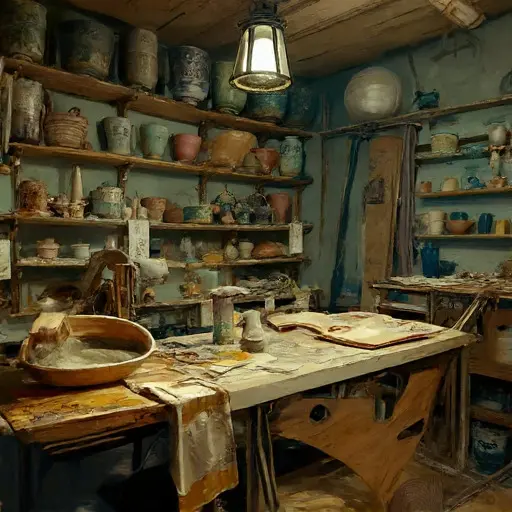
Strain Thickening Beneath Clay and Brine
Behind stacked crocks rests a returned sample labeled “inconsistent opacity.” A bisque cup on the counter shows faint streaks from repeated over-dipping. Ingrid’s stool angles toward the annex door, as though she paced often, recalculating ratios that refused to settle. A bowl of slip sits cooling, its surface rippled by earlier agitation. Thin drips of glaze arc across the tiles, tracing patient, troubled steps from one station to the next.
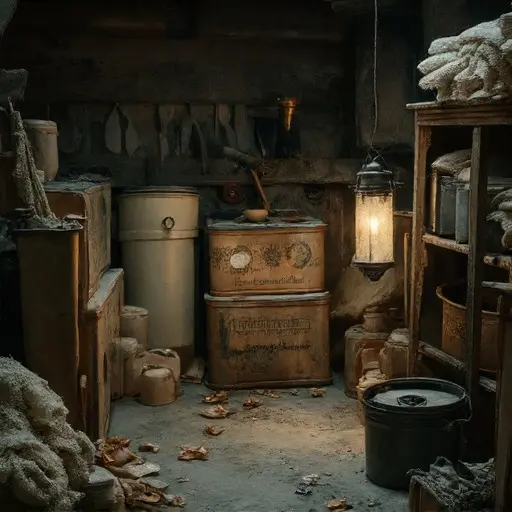
Returning to the pickling annex, one final sign remains: a perfectly balanced vessel beside its uneven companion—certainty and doubt cooling in the same muted glow.
The house remains abandoned.