The Lost Fahmi Mangle Room Where the Arc Slipped Loose
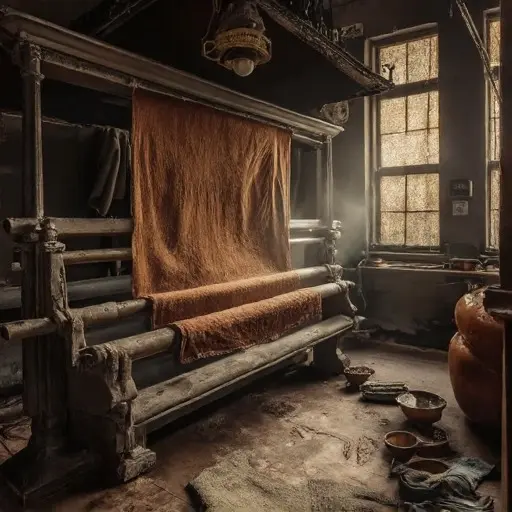
The mangle room smells of iron, turmeric, and faint vinegar. Lanternlight catches threads stretched in interrupted tension, echoing a rhythm that once steadied each motion.
A Dyer Drawn Toward Precise Arcs of Color
Sami Idris Fahmi, born 1877 in Alexandria, dyed modest textiles for shopkeepers and traveling traders.
A cotton wrap from his aunt Maha cushions tools arranged by habit: wooden tongs, dye ladles, and narrow brushes. Sami stirred vats at dawn, tested gradients by midday, and laid cloth across rollers under lantern warmth. His humble upbringing lingers in reused jars, frayed cords, and Arabic-script slips pinned beneath the crank.
Patterns Set Adrift in Warm, Heavy Air
One indigo cloth darkens along its edge, the dye rising too far. A pot of turmeric mordant sits half-cooled beside a cloth stiffened by earlier attempts. A wooden tong leans against the mangle leg, its tips stained irregularly. On the counter rests a folded pattern sheet, the guiding line noticeably uncertain. Even the lantern’s flame tilts toward the rollers, shadowing the wavering outline.

Strain Threaded Through Cotton and Heat
Behind stacked muslin lies a returned note—“uneven banding.” A cloth stretched on the mangle roller shows faint blotches from repeated adjustments. Sami’s stool stands angled toward the hall, suggesting he paced often, pausing only to test small corrections. A brush rests bristles-up, its tips darkened. Thin drips of dye arc across the tiles, marking quiet, looping steps.
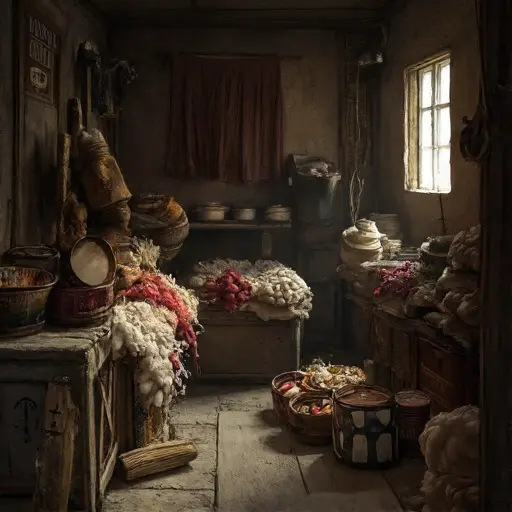
Returning to the mangle room, one final detail lingers: a flawlessly dyed strip beside the wavering arc—certainty and doubt sharing the same cooling air.
The house remains abandoned.