The Veiled Haddad Spice Closet Where the Grain Shifted Oddly
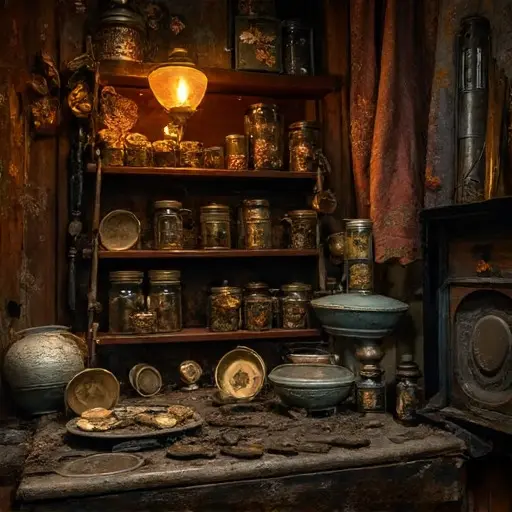
The spice closet carries faint turmeric and cooling metal. Lanternlight trembles over burins aligned with deliberate care, catching on curves that hint at a practiced rhythm slipping somewhere between resolve and fatigue.
A Craftsman Drawn to the Hollow’s Depth
Jamil Omar Haddad, born 1873 in Damascus, engraved modest copperware for nearby merchants.
A linen scrap from his sister Rim cushions his fine-point burins. Jamil traced motifs at dawn, deepened cuts by midday, and polished plates under a dim lamp long past dusk. His humble origins linger in reused blanks and Arabic-script slips tucked beneath spice jars.
Work Hovering Between Spice and Metal
A copper plate leans against a jar of coriander, its outer ring crisp while the inner design spirals off-center. A burin rests on a folded cloth stained with rouge polish. Brass shavings lie scattered in a shallow bowl normally used for cloves. On the shelf, patterns drawn in charcoal smudge toward the edges, softened by repeated, uncertain revisions. Even the lantern’s wick burns unevenly, its glow thinning toward the counter.
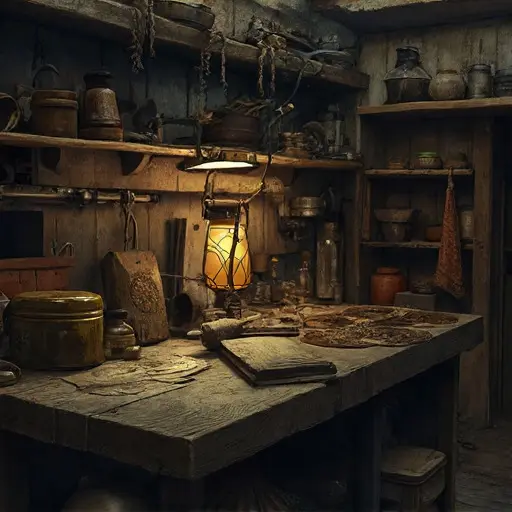
Strain Working Beneath Copper Shine
Behind stacked jars lies a returned note—“central depression uneven.” A plate on the counter shows faint reheating marks, its surface clouded. Jamil’s stool angles toward the doorway, suggesting he rose often, pacing with growing doubt. A polishing cloth curls at the edges, stiff from repeated effort. A trail of filings arcs across the floor tiles, mapping slow, uncertain steps between stations.
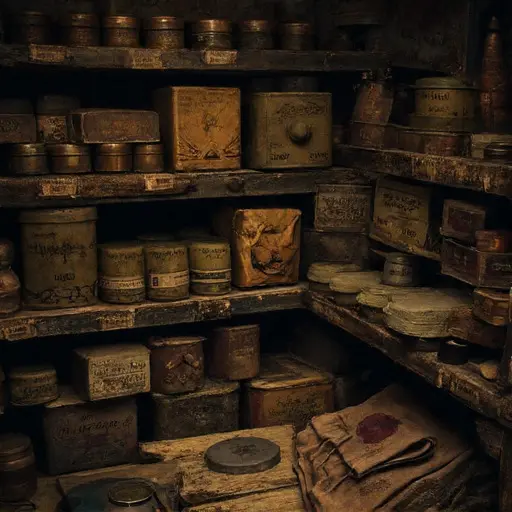
Back in the spice closet, one quiet sign remains: a flawlessly engraved ring beside its wavering partner—certainty and doubt resting in shared hush.
The house remains abandoned.