The Forgotten Hjørland China Anteroom Where the Balance Went Thin
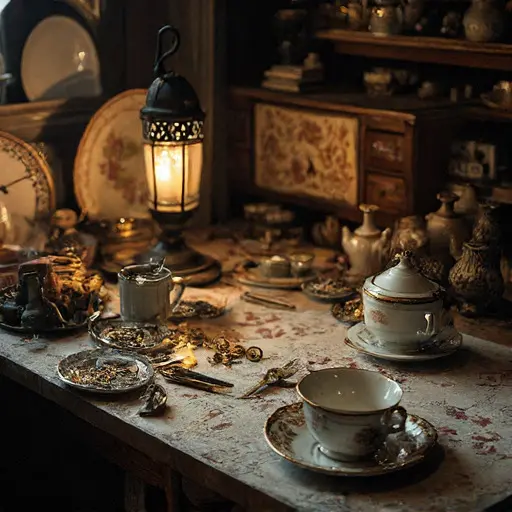
The china anteroom holds a faint aroma of oil and cooled metal. Light pools across porcelain and brass alike, the stillness weaving around parts too small to blame yet too crucial to ignore.
A Repairer Bound to the Weight of Small Errors
Henrik Ola Hjørland, born 1873 in Bergen, tended modest watches for chapel-goers and tradesmen.
A wool square from his sister Liv cushions tweezers and jewel runners. Henrik cleaned movements at dawn, corrected beat rates by midday, and tested balances under lantern warmth at night. His modest means show in repurposed tins and Norwegian-script notes pressed beneath china saucers.
Work Pressed Among Porcelain and Brass
A tea plate hosts a barrel arbor with its hook worn thin. A shallow bowl cradles gears aligned like careful constellations. A cracked porcelain cup holds pegwood bits darkened at their tips. Nearby rests a mainspring strip coiled too tightly, edges marked by hesitant attempts to reshape it. Even the lantern’s glass bears smudges of hurried wiping, its light unsteady.
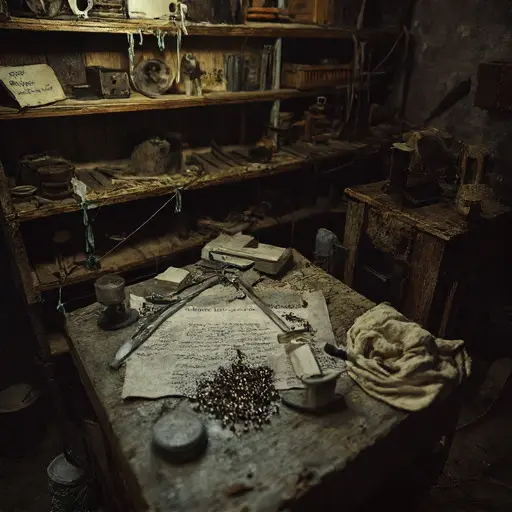
Strain Settling Behind Fragile Mechanisms
Behind a tray of mismatched plates rests a returned note—“uneven amplitude.” A balance jewel sits beside it, its setting chipped. The stool stands angled toward the hall, as though Henrik paced with rising uncertainty. A loupe lies face-down, its rim clouded by oily fingerprints. A gear train, half-reassembled, forms an incomplete circle on embroidered linen—a shape that longs for closure.
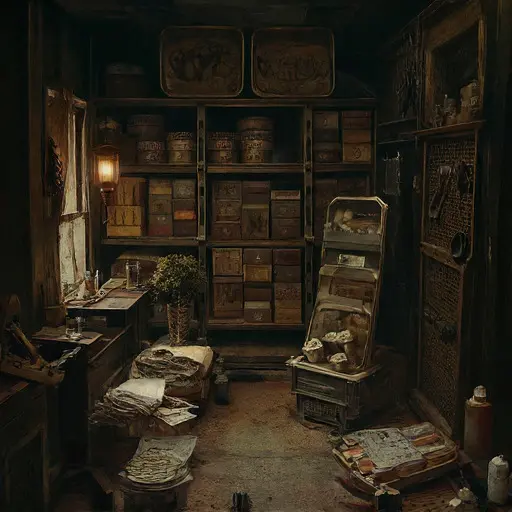
Returning to the anteroom, one quiet mark remains: a flawless pallet fork set gently beside the distorted balance—certainty and doubt sharing the hush of abandoned time.
The house remains abandoned.