The Lost Grigorov Coal Scullery Where the Measure Slipped Wide
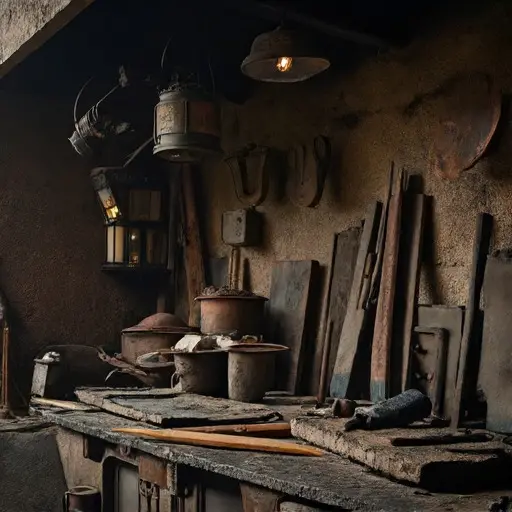
Entering the coal scullery, a coarse mineral scent settles in the lungs. Beneath the lantern’s sway, each slab seems caught at the moment before certainty fractured—angles half-formed, weight balanced yet unsure, as though the room itself waited for a strike that never came.
A Stonecutter Bound to Quiet Weight
Todor Marin Grigorov, born 1873 in Varna, carved modest grave markers for traders and travelers.
A woolen cloth from his sister Velika cushions his chisels. Todor preferred early tracing, midday carving, and dusk smoothing with patient sand. His humble beginnings appear in patched sleeves and tools sharpened on reused slate, their edges honed by careful thrift.
Marks and Measures Across a Sooted Room
Slate tablets rest on a coal bin lid, each etched with Cyrillic letters showing steady confidence—until the last, where a name trails off. A mallet sits near a block bearing an uncertain guiding line. A washtub filled with slurry indicates repeated attempts to correct something subtle, though no single misstep reveals itself. A folded sheet of Bulgarian-script notes lies beneath a crate, edges crumpled from uneasy handling.
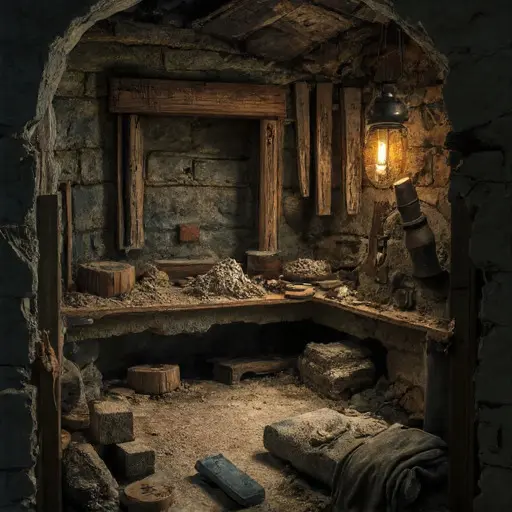
Strain Whispering Beneath Stone and Coal
Behind a bin sits a returned order slip—“incorrect spacing.” A row of practice letters on a thin slate show abrupt realignment mid-line. The stool near the wall stands crooked, as though Todor rose repeatedly, testing angles against lantern glare. A narrow groove in the floor marks pacing drawn in slow arcs. A chisel left edge-down in a crack seems placed with trembling deliberation.
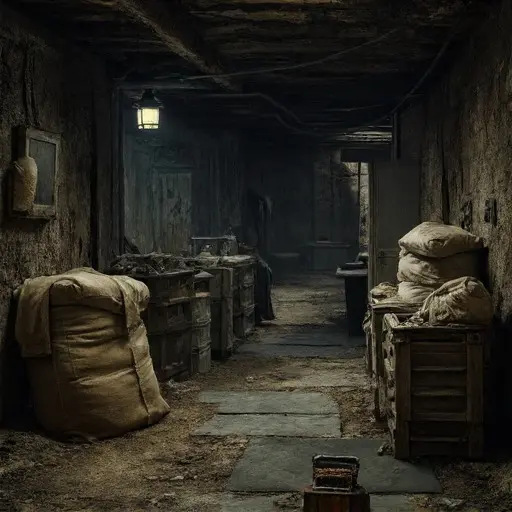
Returning to the coal scullery, one detail remains: a perfect letter carved on a test shard beside the flawed inscription—clarity and doubt resting silently in the half-lit dark.
The house remains abandoned.