The Haunting Almeida Pantry Loft Where the Grain Went Wrong

The pantry loft holds a warm, unsettled hush, scented with oil and cedar. Nothing lies overturned, yet something faltered here—a rhythm of carving slowed into silence, leaving the faint shimmer of intention abandoned mid-gesture.
A Woodcarver Shaped by Quiet Practice
Leandro Paulo Almeida, born 1874 in Minas Gerais, carved modest devotional figures for travelers.
A woven cloth from his sister Rita cushions chisels aligned with modest pride. Leandro began at dawn roughing silhouettes, spent afternoons shaping curves, and worked evenings burnishing delicate details. His simple upbringing shows in reused strops and offcuts labeled in Portuguese script, kept for repairs he promised to finish.
Traces of Craft Pressed Into a Pantry Loft
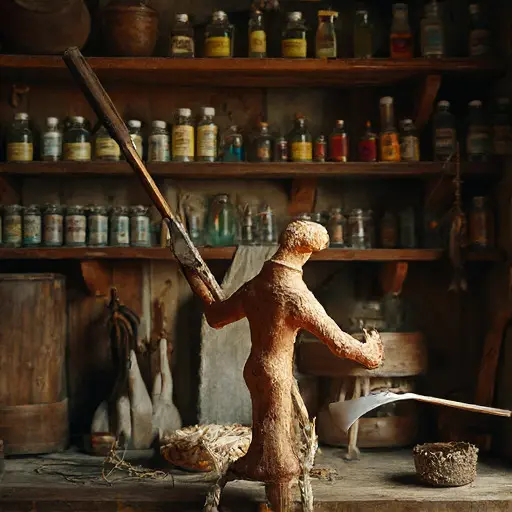
Hardwood blanks rest on flour crates, their surfaces sketched in charcoal lines that do not fully resolve. A carving mallet lies beside a figurine whose arm is roughed in but unrefined. The butcher’s table bears faint arcs where Leandro tested sweeps. A jar of finish sits uncorked, its scent drifting toward the rafters. A folded note listing commissions trembles slightly in the draft, as though handled during a moment of reconsideration.
Strain Gathered Along the Cedar Boards
Behind a crate sits a returned order slip—“uneven contours.” A figurine’s hand, carved too sharply, rests beside the butcher’s table. The stool near the rafters is nudged askew, as though Leandro stood often, stretching aching fingers. A gouge, usually sharpened to a mirror edge, shows a hesitant, irregular bevel. On the floor, wood dust forms a narrow crescent shaped by slow pacing.
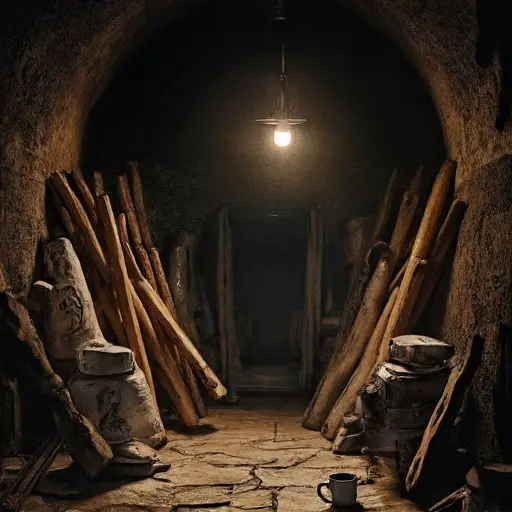
Returning to the pantry loft, one last sign remains: a flawless carving block placed beside its wavering counterpart—hope and hesitation resting quietly in the cedar-scented dark.
The house remains abandoned.