The Hidden Rojas Map Drawer Where the Line Fell Short
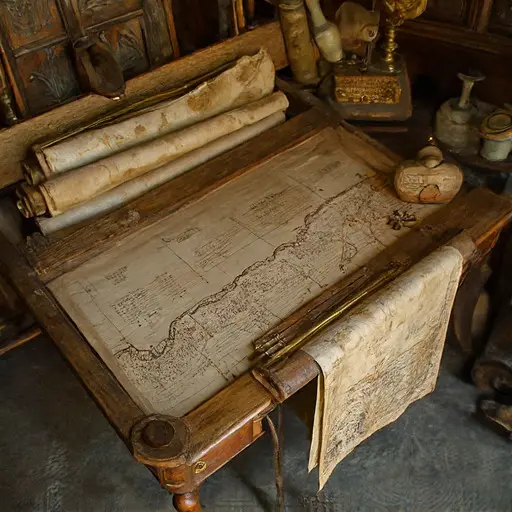
The hush within the map drawer room carries a scent of gum arabic and drying paper. Though nothing lies overturned, the air feels suspended, wrapped in a quiet uncertainty that lingers over half-rendered borders and scale marks caught mid-measure.
A Cartographer’s Days Drawn Close
Julián Esteban Rojas, born 1875 in Valparaíso, charted modest trade routes for travelers.
A small woven cloth from his sister Marisol lies under a cluster of compasses. Julián favored early drafting sessions, checking bearings by midday, then layering ink at dusk when shadows sharpened the fine contours. His modest background shows in carefully cleaned nibs and repurposed parchment sheets weighted with smooth stones.
Coordinates Threaded Through a Narrow Space
Flat drawers hold charts labeled in delicate Spanish script—coastlines, river bends, and port inlets shaped by meticulous practice. A brazier near the wall has cooled, its warmth once used to flatten curled sheets. On the table, a compass arm lies bent, its hinge resisting smooth arcs. A scale bar inked twice reveals a second attempt, its earlier version faint beneath the fresh strokes.
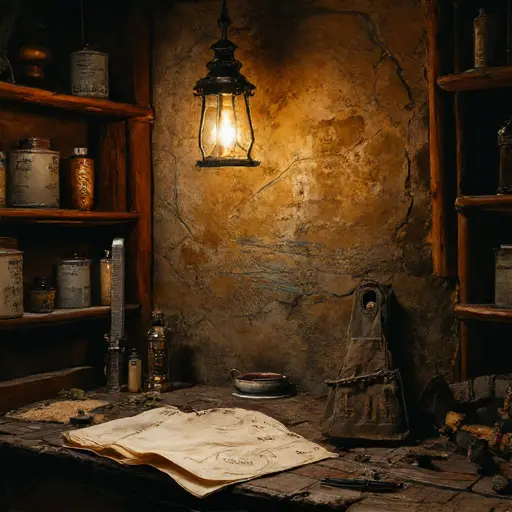
Strain Marked Along the Margins
Behind a stack of charts lies a returned commission slip reading “inaccurate intervals.” A parchment bearing an inland route shows its measures crowded, as if recalculated in haste. The chair stands angled toward the drawer, suggesting pacing that circled around one unresolved figure. A quill trimmed too severely lies on the floorboard, its tip brittle.
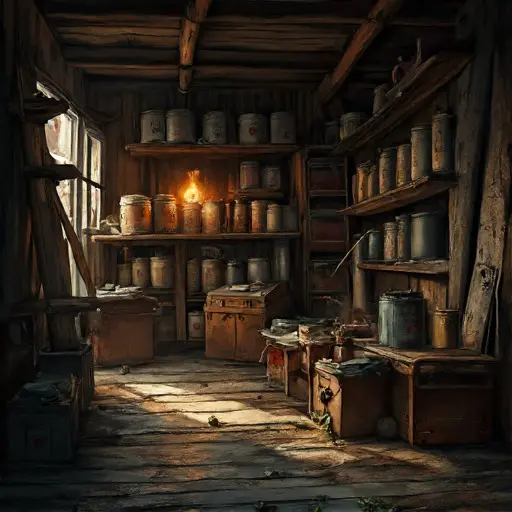
Returning to the map drawer, one detail remains: a flawless coastline on a small scrap placed beside the larger, incomplete chart—precision and doubt held in silent contrast.
The house remains abandoned.