Forgotten Zamora and the Glassblower’s Annealing-Room Where His Line Softened

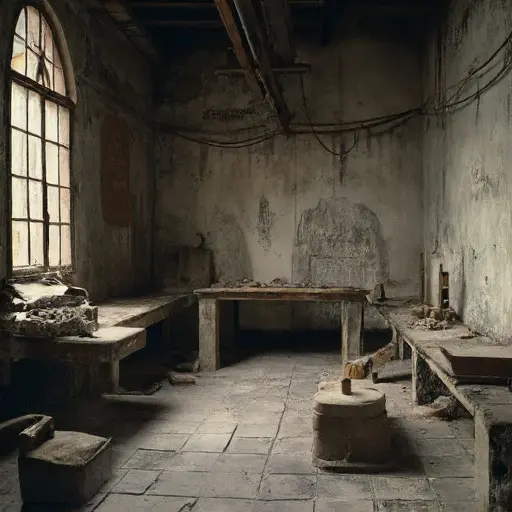
A muted heatless calm hangs through Zamora House, heaviest in the annealing-room where Mateo Raul Zamora, born 1878 in Málaga, once shaped handblown vessels for merchants, apothecaries, and coastal cafés. The softened line on his final cylinder lingers like a hesitation frozen mid-turn. His tools remain arranged with unwavering logic—yet no breath has passed through those pipes since his departure.
A Line Running Through the Glassblower’s Daily Rhythm
Mateo learned the art’s delicate balance from his uncle Luis Zamora, a furnace tender whose bent paddle still rests beside a soot-darkened stool. Each dawn he measured silica by handful, stoked the furnace to its clean blue shimmer, and rolled molten gathers across the marver in practiced arcs. His imprint lingers—paddles stacked by length, molds aligned beside cork-backed templates, faint chalk circles marking where he braced for each drawn line. Even the scorched plank at the furnace’s lip remembers the angle of his stance as he coaxed shape from heat.
A Quiet Pressure That Bent His Craft Off Its Intended Arc
Soft rumor followed when a café owner returned a batch of goblets, claiming their stems slanted unevenly—an unexpected lapse for a glassblower known for symmetry. In the interior corridor, Luis’s paddle pouch hangs torn at the tie. A mold half-filled with cullet rests near the wainscot, its rim chipped though no shard lies close by. Beneath a narrow walnut stand sits a sketch of vessel proportions, its guiding lines overwritten in wavering pencil. A faint trail of silica dust marks a single stair tread—evidence shed from a gather handled with unsteady resolve. None of these fragments confirm error, yet each leans toward a private strain Mateo never voiced.
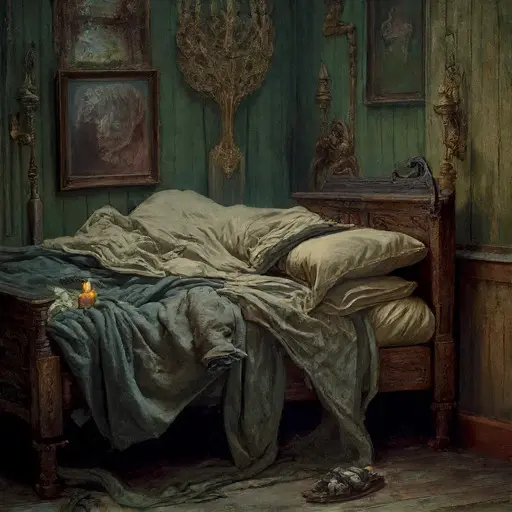
Only the softened line of his final cylinder remains—an intention stalled between heat and stillness. Whatever halted Mateo’s practiced shaping endures unanswered.
Zamora House remains abandoned still.