Lost Harrington and the Naturalist’s Specimen-Library Where His Pattern Frayed
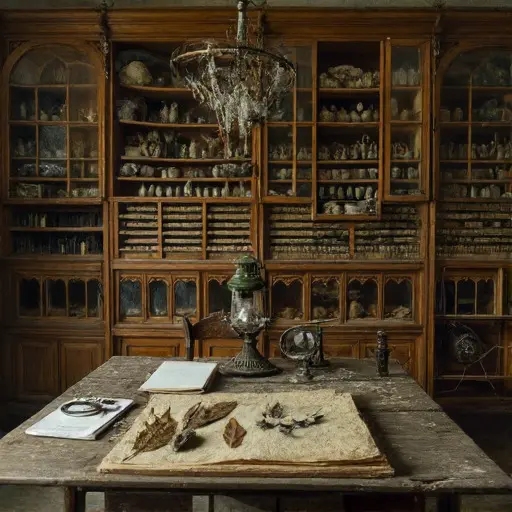
A tempered quiet fills Harrington House, heaviest in the specimen-library where Edwin Arthur Harrington, born 1871 in Dorset, once catalogued regional flora and insects for universities and private collectors. That frayed leaf pattern he left behind hangs like a question caught between observation and doubt. Every instrument remains placed with fastidious care—yet no eye returns to verify the final classification.
A Pattern at the Center of the Naturalist’s Patient Rounds
Edwin learned the calm steadiness of field study from his aunt Margaret Elwood, a countryside botanizer whose chipped vasculum rests near the wainscot. His daily practice endures in the room: envelopes sorted by habitat, glass slides arranged by elevation, and faint pencil ticks marking where he compared venation. A stool near the central table shows the shallow depression of habitual posture, knees drawn close as he sketched a specimen’s pattern before committing it to classification. Even the blotched blotter on the desk recalls his habit of testing ink weight before labeling a sample.
A Quiet Pressure That Pulled His Work Off Its Intended Order
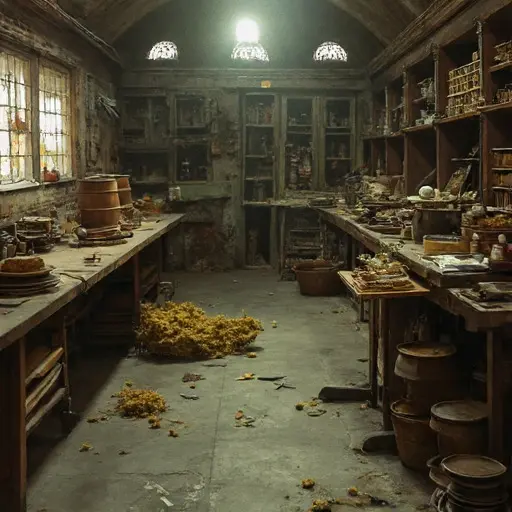
Soft murmurs spread after Edwin submitted a pressed-fern catalogue to a provincial museum containing an unexpected misidentification—one frond mislabeled with a close cousin, a rare lapse from his methodical precision. In the interior corridor, Margaret’s vasculum pouch lies torn at the clasp. A cabinet drawer hangs ajar, its index cards overwritten in wobbling ink. Beneath a narrow umbrella stand rests a magnifying lens, its frame cracked though no shards appear nearby. A faint trail of pale dust marks a single stair tread—shed from a specimen envelope handled with an unsteady grip. These fragments prove nothing outright, yet each leans toward a strain Edwin kept contained behind his measured calm.
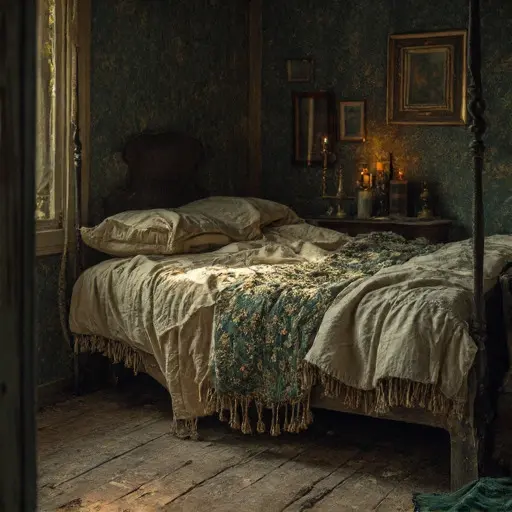
Only the frayed pattern on his last sheet remains—an intention stranded between study and uncertainty. Whatever unsettled Edwin’s practiced taxonomy lingers unanswered.
Harrington House remains abandoned still.