Silent Koenig and the Horologist’s Gear-Room Where His Balance Faltered
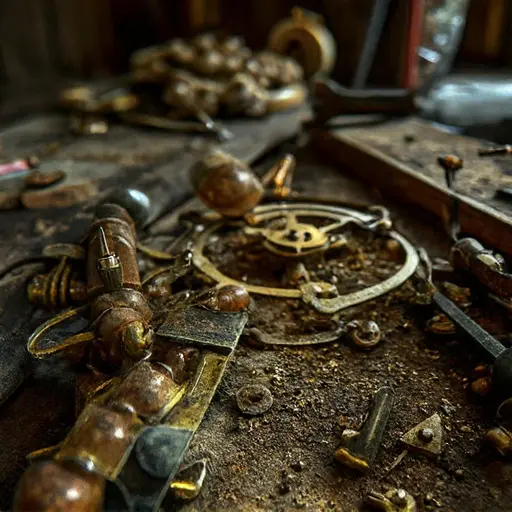
A muted stillness hangs through Koenig House, densest in the gear-room where Johann Emil Koenig, born 1876 in Ulm, crafted and repaired timepieces for shopkeepers, railway clerks, and provincial officials. That faltered balance in his final assembly lingers like a sentence he never completed. Every tool remains arranged in his familiar discipline—yet no hand troubles the silence.
A Balance Woven Through the Horologist’s Exacting Pattern
Johann learned restraint and precision from his father Friedrich Koenig, a master watchmaker whose dented brass caliper rests on a velvet square near the cabinet. Morning routines survive in their positions: tiny screw trays arranged by pitch, jeweling tools aligned in a narrow arc, and chalk marks noting the seat of a stubborn gear. The rug before the bench bears a faint scuff where Johann shifted weight while listening for the thin, bright tic that signaled a mechanism’s steady heart. Even the cooling block beside the lamp remembers the angle of his elbow as he nudged the balance wheel into place.

A Subtle Pressure That Threw His Craft Off Its Intended Beat
Quiet talk suggested a stationmaster’s prized chronometer—expected to certify railway intervals—returned from Johann’s bench running minutes slow, a bewildering error from a maker celebrated for exactitude. In the interior corridor, Friedrich’s caliper pouch lies torn at the edge. A gear-train diagram slumps near the wainscot, its margins overwritten in wavering script. Beneath a narrow oak console rests a balance bridge, one screw missing though none appear scattered nearby. A faint trail of brass filings marks a single stair tread, as though shaken loose from a hand no longer confident in its hold.
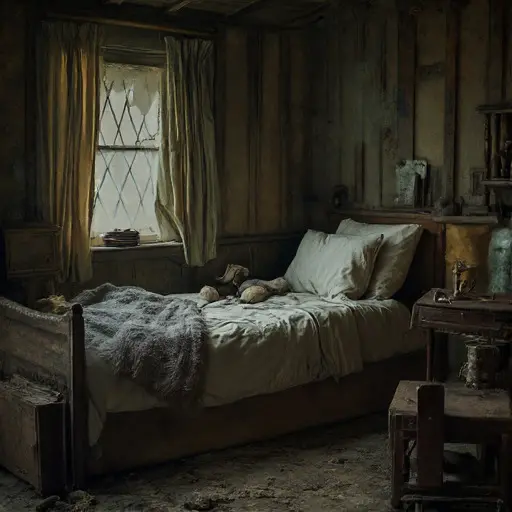
Only the faltering balance in his unfinished clock remains—an intention stranded between motion and silence. Whatever broke Johann’s practiced precision endures without answer.
Koenig House remains abandoned still.