Eerie Okabe and the Toy-Repair Room Where His Designs Unraveled
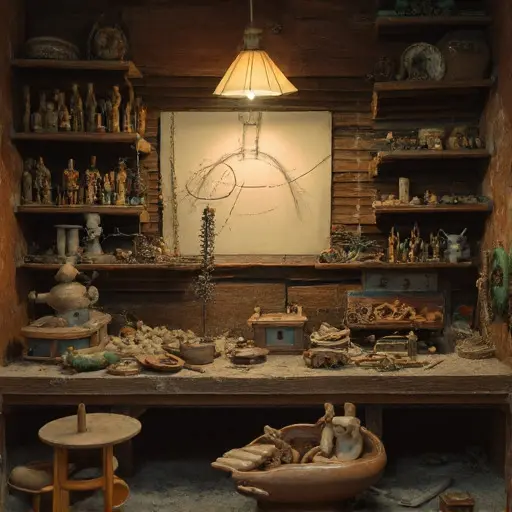
A muted quiet settles across Okabe House, thickest in the abandoned toy-repair room where Haruto Kenji Okabe, a modest craftsman who restored children’s mechanical playthings, once coaxed motion from fragile joints. Now the thinned curve on his final sketch lingers like the breath of a choice he left unanswered.
The Curve Threaded Through His Careful Rhythm
Haruto, born 1879 in Nagoya, learned joinery from his father Masaru Okabe, whose cracked awl rests near a cedar drawer.
His evenings followed careful repetition: brass gears polished with rice paper, wooden bearings shaped with soft strokes, winding keys tested against a cloth mat. His order remains—springs coiled on shallow trays, dolls arranged for mending, shavings folded into tidy bundles. Even the worn groove in the table recalls where he braced his wrist before cutting a delicate arc that determined whether a toy danced or failed.
When His Craft Stepped Out of Line
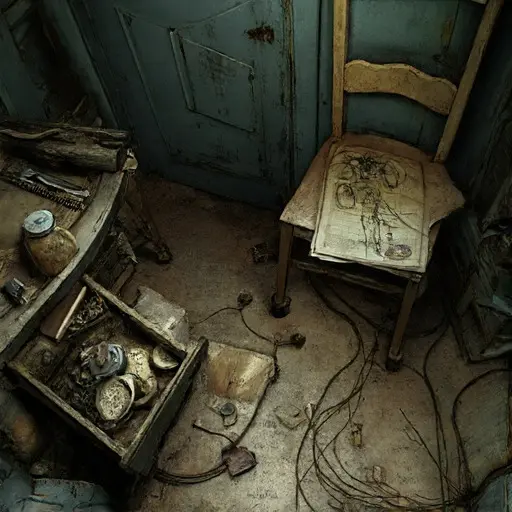
Soft rumor said a cherished mechanical bird—brought by a traveling merchant—jammed after Haruto’s restoration, its wings catching in mid-flutter. In the interior corridor, Masaru’s awl pouch lies torn at the tie. A gear case leans against the wall, its contents spilled in a crooked path. A sheet of recalculated ratios sits beneath a lantern stand, figures overwritten in uneven strokes. A broken winding key rests on a stair tread, its edges dulled by hurried handling. None of these fragments confirm failure, yet each leans toward a doubt he carried privately.
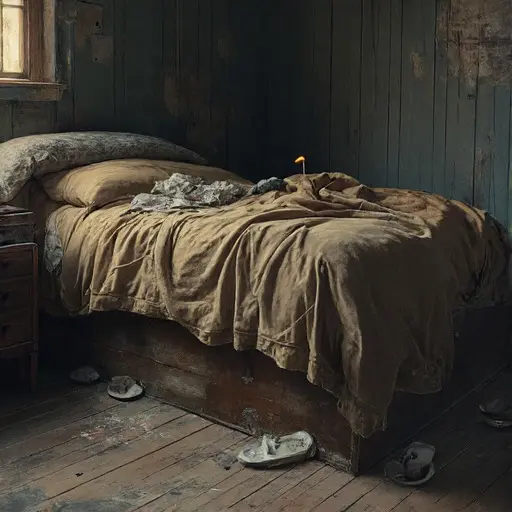
Only the fading curve on his final draft remains—an unfinished gesture suspended in stillness. Whatever stilled Haruto’s hands endures unresolved.
Okabe House remains abandoned still.