Hidden Duarte and the Rope-Drying Loft Where His Knots Slipped
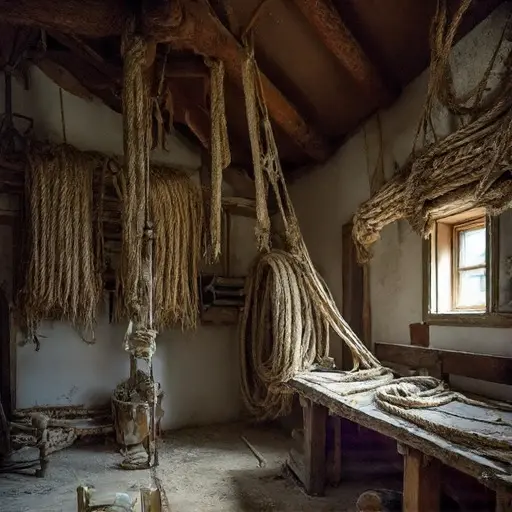
A slow, withheld hush permeates Duarte House, thickest in the abandoned rope-drying loft where Brás António Duarte, a coastal rope-maker supplying nearby boatyards, once braided strength into the simplest of materials. Now the uncertain slip on his final practice line lingers like a hesitation he never resolved.
A Slip Within the Rope-Maker’s Everyday Rhythm
Brás, born 1871 near Porto, learned splicing from his father Armando Duarte, whose cracked marlinspike rests at the foot of the measuring post.
His mornings traced a steady sequence: hemp softened with warm water, fibers combed across the loft planks, cords twisted by hand while counting each turn aloud. Order remains—pitch tins arranged by thickness, fids lined on a narrow shelf, loops of cord hanging in graded arcs. Even the worn groove in the bench’s edge recalls where he braced his knee while tightening a critical knot.
When His Craft Drifted from Its Intended Course
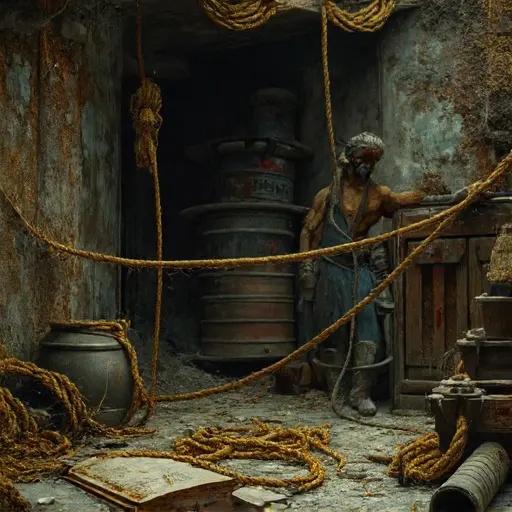
Rumor murmured that a mooring line Brás supplied parted too easily during a mild storm, embarrassing a fisherman who had trusted his work. In the interior corridor, Armando’s marlinspike pouch lies torn, its seam strained. A half-braided cord lies crooked near the wainscoting, tension inconsistent along its length. A sheet of recalculated twist ratios rests beneath a lantern stand, final columns overwritten. A stray coil trails down the stair, its fibers shedding as though shaken loose. None of these fragments prove fault, yet each leans toward a doubt he tried to shoulder quietly.
Only the fraying slip on his final rope endures—an unfinished effort resting in stillness. Whatever stilled Brás’s craft remains unanswered.
Duarte House remains abandoned still.