Eerie Makris and the Marble-Carving Cellar Where His Strokes Lost Their Weight
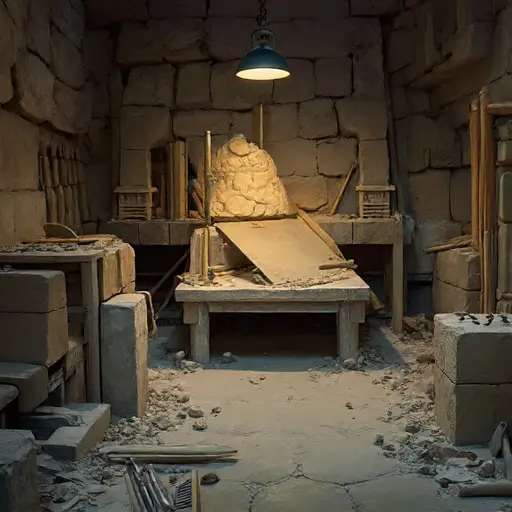
A low, grainy quiet inhabits Makris House, gathering most densely in the abandoned marble-carving cellar where Dimitrios Nikos Makris, a modest Greek stonemason who shaped domestic lintels and small sculptures, once carved steady forms into permanence. Now the weakened pressure on his last slate lingers like the trace of a decision he could not finish.
A Pressure Through the Mason’s Disciplined Hours
Dimitrios, born 1872 in Patras, learned chisel balance from his uncle Stathis Makris, whose cracked bevel gauge rests beside a jar of limestone dust.
His evenings followed a firm cadence: stone blocks dampened for carving, chisels honed near the lantern’s glow, outlines chalked in slow, measured arcs. His order remains—mallets grouped by weight, wedges aligned in a careful row, templates pinned to wooden beams. Even the indentation on the cellar mat recalls the way he braced his stance before committing to a decisive strike.
When His Craft Drifted Beyond His Reach
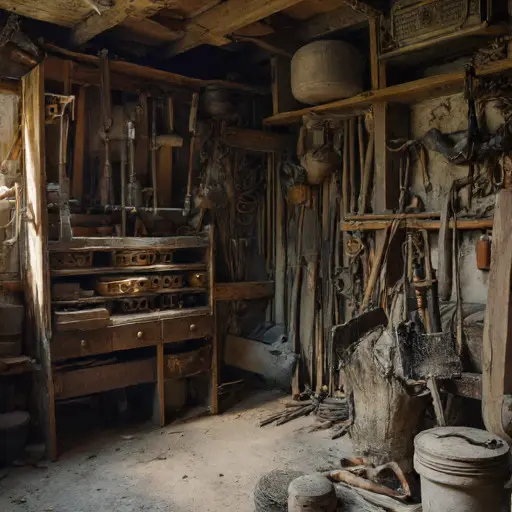
Quiet rumor suggested that a commissioned household relief cracked along an unexpected fault line, prompting doubts from the family who ordered it. In the inner hallway, Stathis’s bevel gauge pouch lies torn at the seam. A split chisel rests near the wainscoting, its tip flattened. A scrap of revised measurements leans against the baluster, final ratios overwritten nearly to illegibility. A drift of pale dust trails down the stair, as though shaken loose in hurried motion. None of this confirms error, yet each sign tilts toward a strain he bore alone.
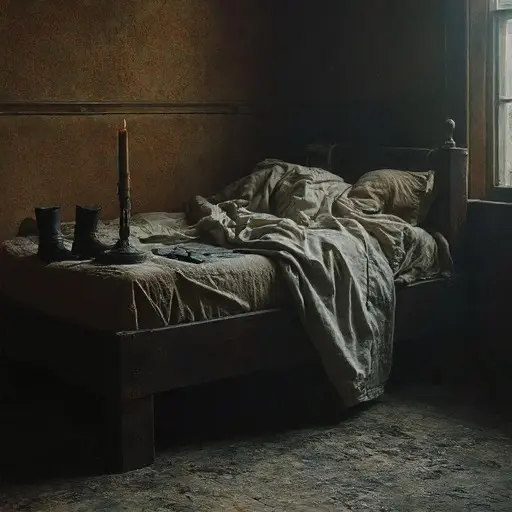
Only the waning pressure on his final guide stroke remains—an unfinished intention resting in quiet. Whatever stilled Dimitrios’s craft endures unanswered.
Makris House remains abandoned still.