Shrouded Tanaka and the Attic Tea-Roasting Room Where His Aromas Thinned
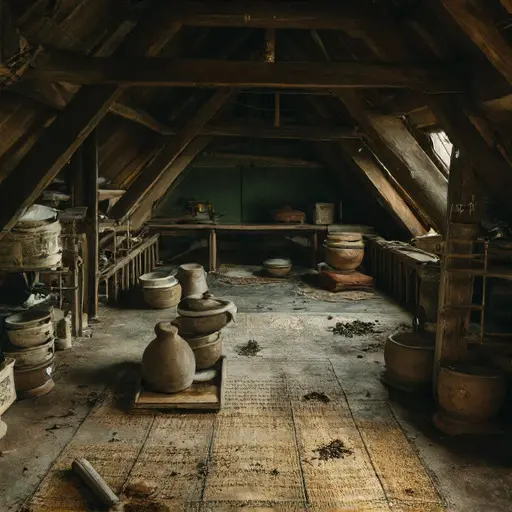
A muted calm rests over Tanaka House, heaviest in the abandoned attic tea-roasting room where Kenji Satoru Tanaka, a small-scale tea roaster known in his neighborhood for delicate pan-firings, once shaped flavor with patient wrists. Now the weakened breath traced across his final tasting slip lingers like a question he approached, then left to settle on its own.
A Breath Within the Roaster’s Ritual
Kenji, born 1876 in Shizuoka, learned slow-roasting methods from his grandmother Sakura Tanaka, whose chipped bamboo scoop lies near the hearth.
His late mornings unfolded in soft rhythms: warming pans over a muted flame, rolling leaves by hand, checking scent by lifting small tufts toward lamplight. His ordering persists—trays arranged by finish, cloths folded into tidy quarters, brushes leaning neatly along a porcelain jar. Even the worn dip in the tatami recalls where he knelt to judge whether a leaf had grown too bright or too dull in aroma.
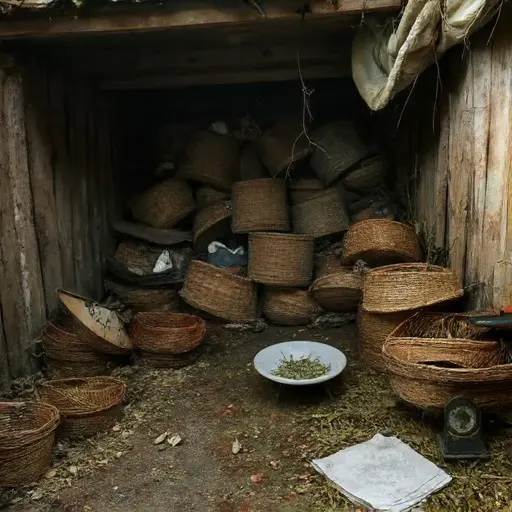
When His Craft Strayed Beyond Confidence
Quiet talk drifted through the neighborhood: a commissioned blend—intended for a wedding gathering—brewed bitterly despite his careful notes, stirring embarrassed murmurs. In the inner corridor, Sakura’s bamboo scoop pouch lies torn at the seam. A tray of sample leaves rests strewn along the baseboard, their hues uneven. A slip of roasting adjustments sits beneath a cabinet, its last ratios overwritten. A whisk has rolled toward the stair, leaving a faint trail of dust where its handle dragged. These signs resolve nothing, yet all tilt toward a burden he tried to carry without acknowledging its weight.
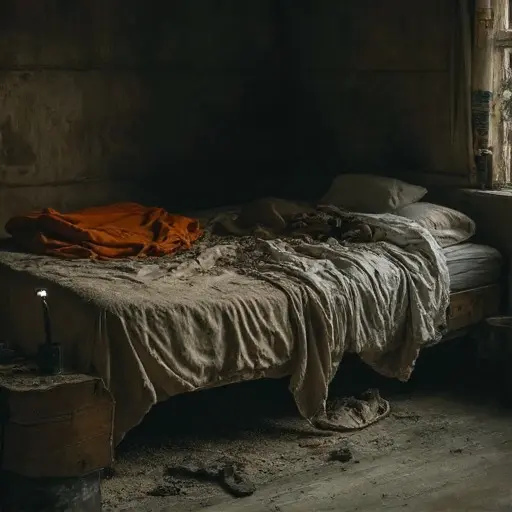
Only the fading breath on his final slip survives—an unfinished measure suspended in quiet air. Whatever stilled Kenji’s craft remains unresolved.
Tanaka House remains abandoned still.