Forgotten al-Khatib and the Herb-Steeping Parlour Where His Measures Clouded
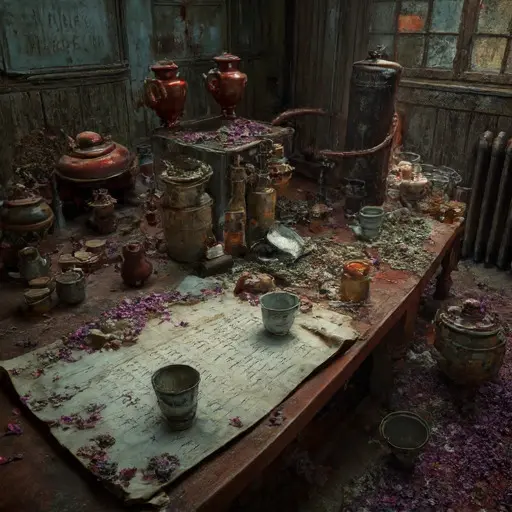
A muted heaviness lingers inside al-Khatib House, dense in the herb-steeping parlour where Yusuf Khalil al-Khatib, a Levantine home-apothecary who blended soothing infusions for neighbors, once worked by lamplight. Now the quivering mote on his final formula hints at a conclusion he never allowed to take shape.
A Mote Inside the Apothecary’s Gentle Rhythm
Yusuf, born 1872 in Aleppo, learned steeping methods from his mother Hanan al-Khatib, whose cracked clay strainer rests near the brazier.
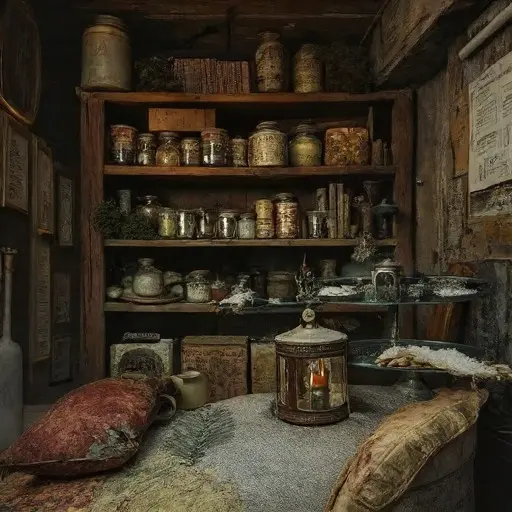
His evenings followed a quiet sequence: herbs sorted by potency, oils warmed over low flame, mixtures strained through layered cloth. His order remains—scales aligned on the mantel, copper spoons nested in a bowl, muslin squares folded with tender precision. Even the wane in the table’s varnish recalls the place where his forearm often rested while testing the scent of a blend.
Where His Craft Drifted Out of Balance
Whispers claimed Yusuf’s latest infusion—prepared for a convalescent neighbor—brought dizziness instead of calm, though no one agreed on the cause. In the interior corridor, Hanan’s clay strainer pouch lies torn beside a toppled cup. A folded note of corrections rests near the wainscoting, last figures overwritten. A stopper from a tincture phial has cracked where it struck the floor. A trail of rosemary needles circles toward the stair, their pattern broken. Nothing here proves error, yet each fragment bends toward a doubt he carried inward.
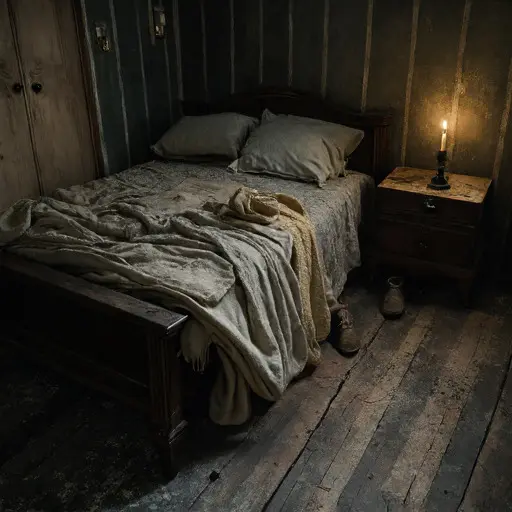
Only the fading mote on his last formula remains—an unfinished measure suspended in stillness. Whatever stilled Yusuf’s hand lingers unanswered.
al-Khatib House remains abandoned still.