Eerie Haddad and the Brass-Workshop Loft Where His Measures Lost Their Curve
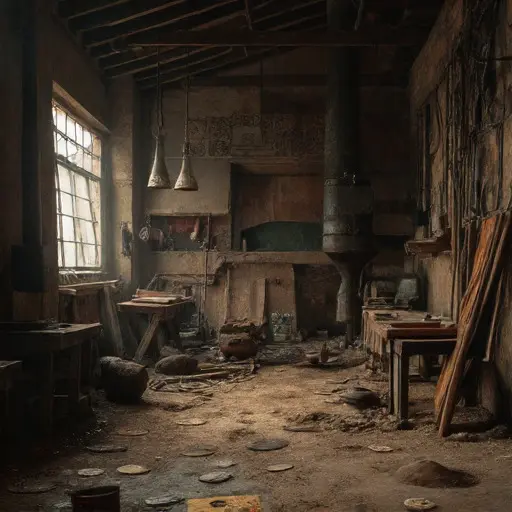
A muted density fills Haddad House, heaviest in the abandoned brass-workshop loft where Samir Fouad Haddad, a Damascene metal engraver who crafted domestic trays and incense burners, once practiced his careful art. Now the trembling curve on his final etching sheet clings like a breath caught between doubt and decision.
A Curve Inside the Engraver’s Patient Method
Samir, born 1871 in Damascus, learned pattern alignment from his uncle Nadim Haddad, whose cracked burnisher rests beside the loft’s doorway.
His daylight hours unfolded in deliberate rows: heating alloys over the brazier, tracing motifs onto waxed surfaces, tapping shallow lines in slow, coaxing rhythms. His ordering remains—chisels grouped by fineness, cloths folded into oil-soft stacks, templates arranged in quiet sequence along the sill. Even the stool’s worn edge recalls the slight lean of his posture when inspecting the depth of a new cut that refused to settle cleanly.
Where His Confidence Shifted Out of Alignment
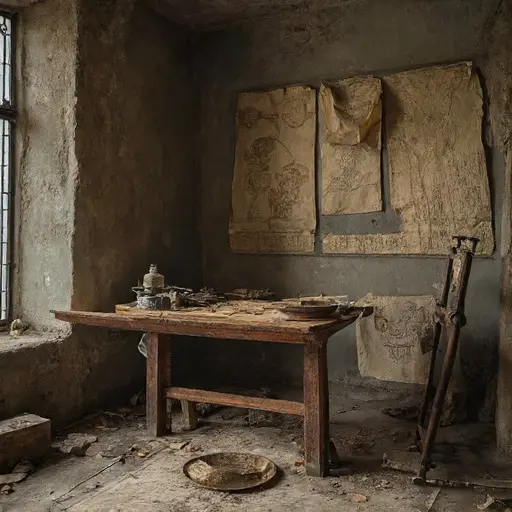
Quiet rumor claimed Samir’s latest commission—an ornate burner intended as a wedding gift—displayed uneven symmetry, disappointing a family who prized precision. In the upper passage, Nadim’s burnisher pouch lies torn along its seam. A plate of half-finished rosettes rests crookedly against the wall, hammer marks scattered out of sequence. A folded stencil has fallen beside the baluster, its final panels scratched out. Tiny curls of copper cling to the floorboard in a lonely drift. None of these details confirm misjudgment, yet each bends toward an unspoken burden.
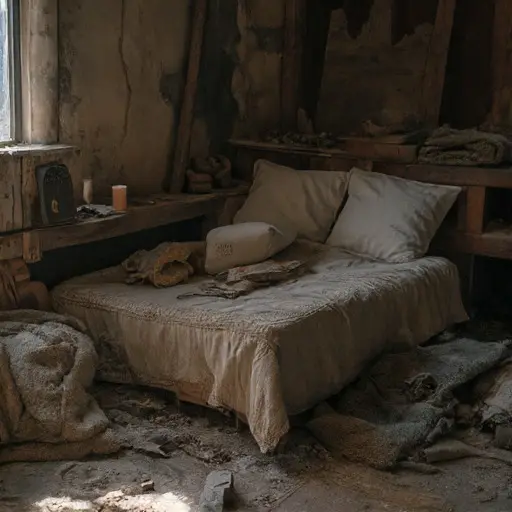
Only the wavering curve on his final etching endures—an unfinished gesture resting in suspended quiet. Whatever stilled Samir’s craft remains unsolved.
Haddad House remains abandoned still.