Forgotten Pettersson and the Looming Pantry Where His Measures Entangled
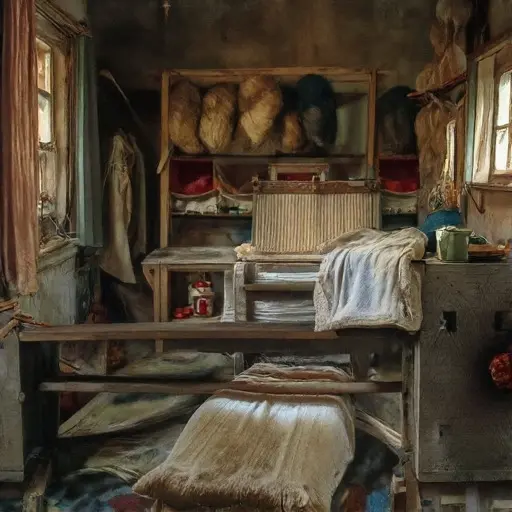
A subdued hush settles over Pettersson House, heaviest in the abandoned looming pantry, where Erik Olof Pettersson, a rural Swedish home-weaver who sold cloth to nearby farms, once worked between family meals and long winter nights. Now the suspended strand on his loom clings like a question he stepped away from before recognizing its shape.
A Strand Running Through the Weaver’s Quiet Hours
Erik, born 1875 near Västerbotten, learned carding and loom-settling from his mother Astrid Pettersson, whose cracked heddle rod leans against the pantry wall.
His evenings unfolded in rhythmic order: wool teased by lamplight, reeds straightened with steady fingertips, dyes cooled in enamel pots that once held preserves. His traces remain—warp threads aligned with meticulous care, patterns sketched on butcher paper, shuttles stacked neatly inside a sugar crate. Even the sagging stool before the loom remembers the slight forward tilt of his posture when a motif pressed him toward deeper attention.

Where His Work Drifted Out of Pattern
Local talk murmured that Erik’s latest cloth commission—intended for a merchant’s winter garments—shrank unpredictably after washing, prompting accusations of poor binding. In the narrow hallway, Astrid’s heddle rod case sits torn, its tie broken. A bolt of unfinished fabric has toppled against the wall, edges fraying in uneven angles. A slip of order notes lies on the floorboard, its final figures overwritten in distress. A spool of dyed yarn has rolled toward the stair, unwinding in a pale spiral like a path he refused to follow. None of it proves fault, yet each sign leans toward a burden he kept close.
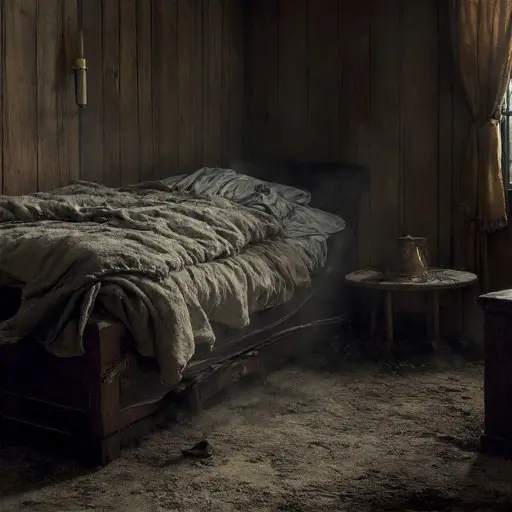
Only the lone strand stretched across his loom remains—an interrupted thought suspended in stillness. Whatever stilled Erik’s final pattern lingers in these abandoned rooms.
Pettersson House remains abandoned still.