Hidden Beaumont and the Map-Room Where His Bearings Faded
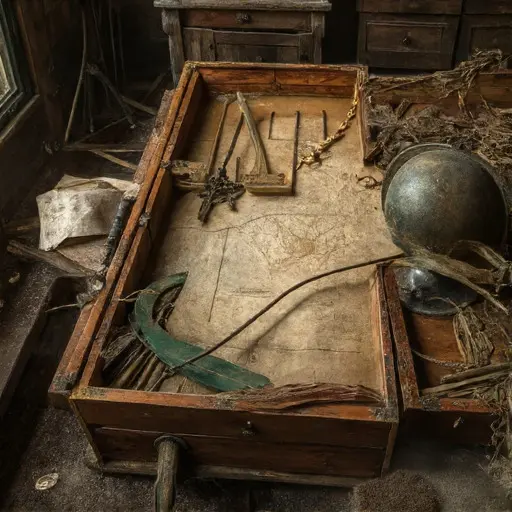
A muted gravity hangs over Beaumont House, deepest in the abandoned map-room, where Henri Jules Beaumont, a French cartographic draftsman of modest acclaim, once shaped coastlines and provinces with a patient, practiced eye. Now the red signal on that coastal chart is all that remains of a moment when his accuracy faltered.
A Signal in the Draftsman’s Quiet Labors
Henri, born 1874 in Arles, learned careful plotting from his aunt Cécile Beaumont, whose cracked ivory protractor still rests on the table.
His evenings spun out in measured ritual: flattening vellum beneath brass weights, sharpening pencils with a paring knife, humming folk songs as he inked rivers into slender arcs. His habits linger in stillness—weights aligned by size, brushes drying beside a chipped ceramic bowl, notes scrawled in tidy margin script. Even the groove worn into the table’s edge recalls the angle of his forearm, braced as he traced uncertain borders.
Where His Bearings Drifted from the Mark
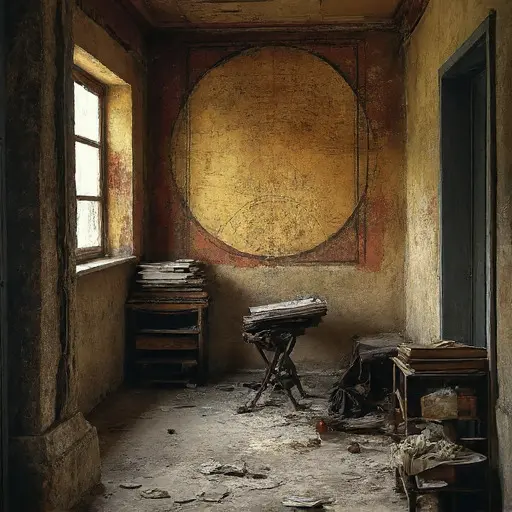
Neighbors whispered that Henri’s last commission—for a local navigation office—misplaced two estuary depths, leading to confusion in shipping projections. In the narrow hallway, Cécile’s protractor case lies split at its hinge. A rolled chart has unraveled across the floor, revealing a coastline smudged by a damp thumb. A compass needle sits detached from its housing, glinting beneath a console. A slip of paper bearing hastily crossed-out bearings rests against a stair tread. These remnants echo a faltering certainty, though none of them name the source.
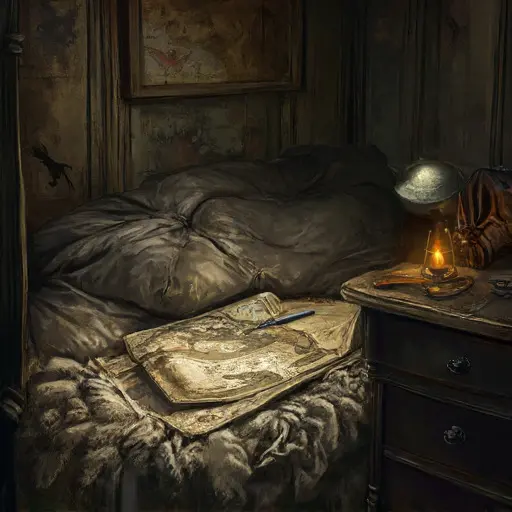
Only the abrupt signal on the coastal margin remains—an unanswered gesture in ink. Whatever stilled Henri’s last attempt at clarity lingers in these abandoned rooms.
Beaumont House remains abandoned still.