Forgotten Rahman and the Morning Room That Misread His Reaction
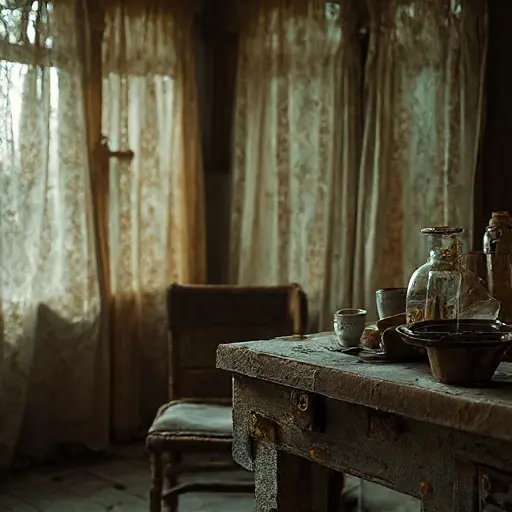
A tempered hush spreads through Rahman House, collecting deepest in the abandoned morning room, where Dr. Saifuddin Rahman, a Calcutta-born household chemist and self-taught nutritional researcher, once tested mild tinctures for common ailments. Now the muted flare on that displaced flask marks the last moment his certainty held a fragile seam.
A Flare in the Chemist’s Domestic Routine
Saifuddin, born 1873 in Dhaka, learned rudimentary compounding from his uncle Farzan Rahman, whose glass stirring rod rests cracked along the table’s edge. His mornings unfurled in unhurried order: warming milk on the stovetop, crushing herbs in a porcelain bowl, comparing dilutions while sunlight crept across the rug. Fragments of his discipline remain—the flasks arranged by purpose, notes weighed down with a spoon, cloth filters folded into neat quarters. Even the sag of the wicker chair remembers his leaning posture, shoulders tipped toward each quiet reaction as though listening for its promise.
Where His Measurements Drifted Off-Scale
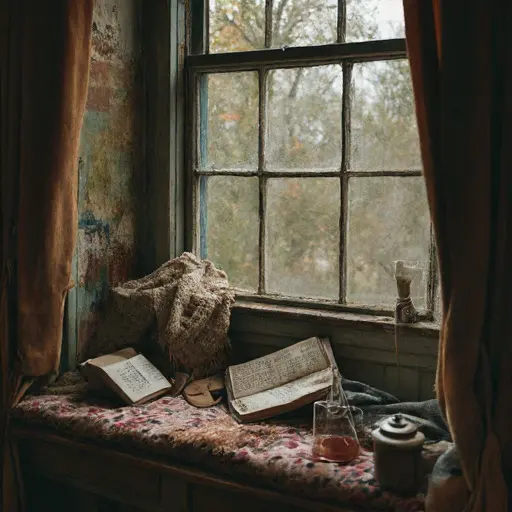
Local rumor suggested that Saifuddin’s restorative tonic, delivered in kindness to a neighbor, intensified rather than eased her weakness. In the narrow hallway, Farzan’s stirring rod lies in two pieces near a scuffed baseboard. A stack of correspondence sits tilted on the console, one letter torn open with uneven force. A vial of turmeric solution has rolled beneath a shoehorn, leaving a faint trail across the tile. A page of calculations lists ratios hurriedly crossed out. These traces hold no verdict, yet they gather into a portrait of uncertainty wearing through his practiced calm.
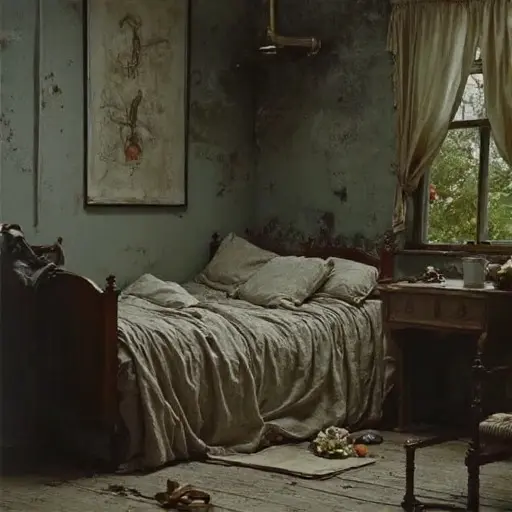
Only the faint flare upon the displaced flask remains—an unfinished reaction in dust and silence. Whatever stilled Saifuddin’s final experiment lingers in these abandoned rooms.
Rahman House remains abandoned still.