Eerie Fournier and the Clock-Room Where His Balance Slipped
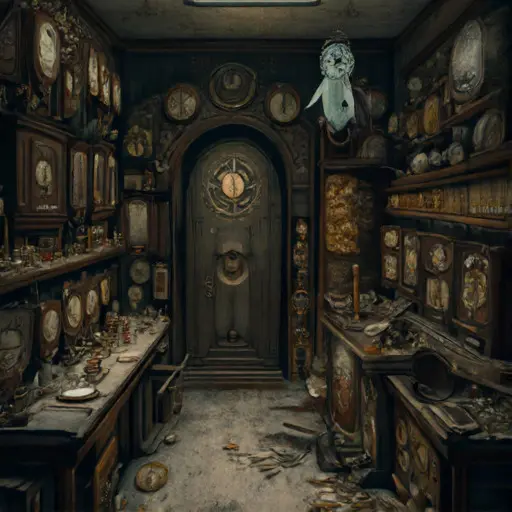
A close, weighted hush gathers inside Fournier House, deepest in the abandoned clock-room, where Étienne Louis Fournier, a provincial French horologist of modest repute, once coaxed order from rows of meticulous gears. Now the slight tilt in that pocket watch’s balance wheel stands as the only surviving clue to a calculation he never corrected.
A Tilt Beneath the Horologist’s Careful Cadence
Étienne, born 1870 near Lyon, learned the earliest subtleties of gear ratios from his grandfather Lucien Fournier, whose cracked winding key rests near the bench.
His evenings followed an unwavering cycle: oiling pivots with a feather’s end, aligning escapements against the bench lamp, and setting finished clocks to a shared rhythm he could hear even with eyes closed. Evidence of his rituals lingers—tiny screws sorted into porcelain dishes, blue-tempered springs wrapped in cloth, sketches of gear trains tucked beneath a candlestick. Even the scuffed floor by the bench holds the imprint of his stance, angled toward whatever mechanism refused perfect balance.

Where His Precision Drifted from Its Course
Whispers lingered that Étienne mis-repaired a merchant’s prized Breguet mantel clock—its timing running erratically after his adjustments, prompting quiet accusation and withheld payment. In the narrow corridor, Lucien’s winding key lies dented along one edge. A box of spare gears has tipped from a shelf, wheels scattered in a soft metallic arc. A folded invoice sits on the floor, ink smudged where a thumb pressed too hard. A pendulum rod leans against the wall, its bob twisted slightly off-center. Nothing declares guilt, yet these remnants incline toward a craftsman losing confidence in the work that once steadied him.
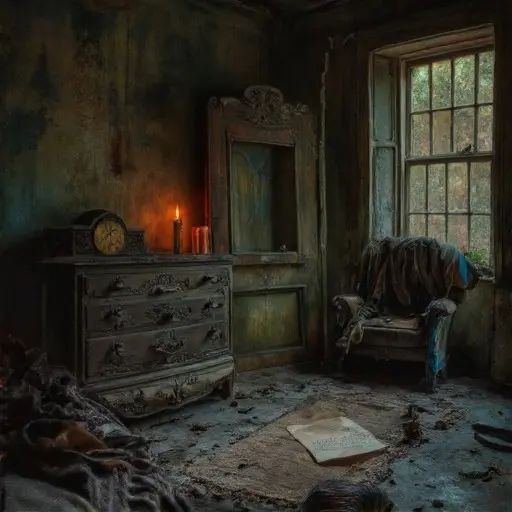
Only the slight tilt of the balance wheel remains—an unfinished negotiation between order and failure. Whatever halted Étienne’s final repair lingers in these abandoned rooms.
Fournier House remains abandoned still.