Hidden Varga and the Side Chamber That Misread His Remedy
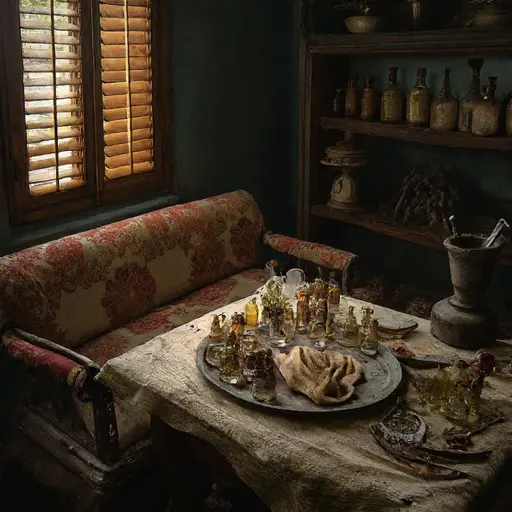
A tempered stillness settles inside Varga House, gathering most densely in the abandoned side chamber, where Béla Andor Varga, a village herbal diagnostician, once blended cures beside ordinary furnishings instead of a formal apothecary. Now the drifting residue in that tilted vial seems to listen for words he never spoke.
A Drift Along the Healer’s Patient Rituals
Béla, born 1871 near Debrecen, learned his first preparations from his grandmother Ilona Varga, whose carved wooden spoon lies faded beside the tray.
His days followed measured routines: morning steepings brewed in a dented kettle, afternoon consultations scribbled on scraps of lace, and evening tinctures tested quietly under lamplight. His order endures in soft remnants—labels written in tidy Magyar script, tinctures grouped by season, cloth wraps folded into precise quadrants. Even the sofa’s slumped cushion remembers his posture, bent forward as he weighed each mixture’s worth.
Where His Work Lost Its Bearing
Rumor lingered that Béla misjudged a fever cure for a respected neighbor’s daughter—too strong, some said—though nothing was proved. In the hallway bend, Ilona’s spoon shows a fresh split along its grain. A vial has rolled beneath a low cabinet, powder settled in a fine crescent around it. A pouch of herbs sits torn, stems scattered in a fading trail. A torn note of ratios rests on the floorboard, its final figures crossed out in hurried strokes. These pieces never speak directly, yet together they lean toward a fracture he carried unannounced.
Only the drifting residue in the tilted vial remains—an unfinished thought clouding the chamber’s stale air. Whatever stilled Béla’s final preparation endures in these abandoned rooms.
Varga House remains abandoned still.