Veiled Sørensen and the Washroom That Held His Translation
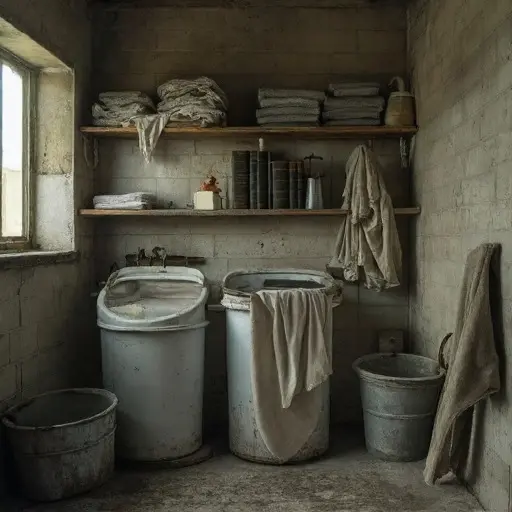
A dim, breathless calm seeps through Sørensen House, deepest in the abandoned washroom, where Leif Mads Sørensen, a translator of folk epics and itinerant tutor, once perched his manuscripts atop laundry piles for lack of a proper study. Now the thin thread of notation peeking from the folio offers the only sign of a question he never managed to settle.
A Thread Running Through the Translator’s Quiet Hours
Leif, born 1872 in Aarhus, first learned the cadences of saga poetry from his sister Astrid Sørensen, whose cracked reading spectacles rest on the basin’s rim.
His days fell into humble pattern: morning tutoring in the parlor, afternoons spent reciting verses under his breath, evenings translating lines by lamplight while water cooled in forgotten basins. Evidence of his method lingers—pages clipped with wooden pins, glossaries stacked near soap tins, towels folded to support a drifting manuscript’s spine. Even the stool beside the rack remembers the tilt of his posture, leaning toward whatever riddle the next stanza held.
Where His Words Drifted Off Their Course
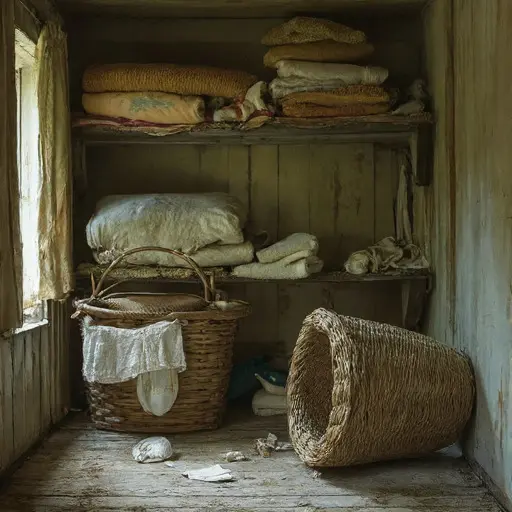
Neighbors murmured that Leif misinterpreted a local family’s ancestral verse, altering a phrase that referenced a marriage bond; the error ignited a quiet dispute he could not mend. In the narrow hallway, a sheaf of notes lies crumpled near a tipped pail, water long evaporated. Astrid’s spectacles case sits cracked along the hinge. A Danish–Icelandic lexicon has fallen open on the floor, exposing pages wrinkled by moisture. A bit of charcoal used for phonetic marks leaves smears across the wainscoting. Each trace leans toward distress yet never states precisely how the rupture began.
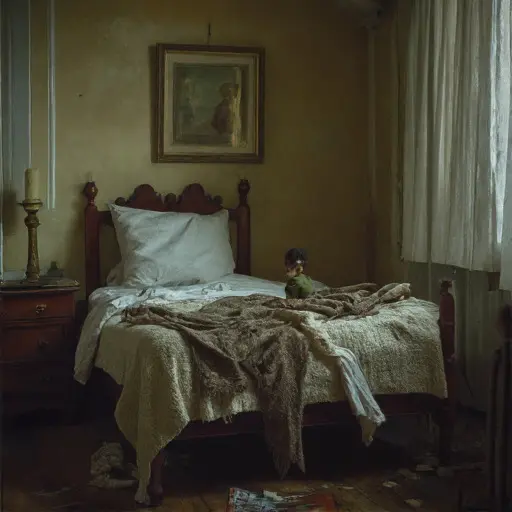
Only the drifting thread of notation peering from the washroom folio remains—an unfinished bridge between languages. Whatever stilled Leif’s final translation lingers in these abandoned rooms.
Sørensen House remains abandoned still.