Eerie Fontaine and the Sitting Room That Kept His Equations Waiting
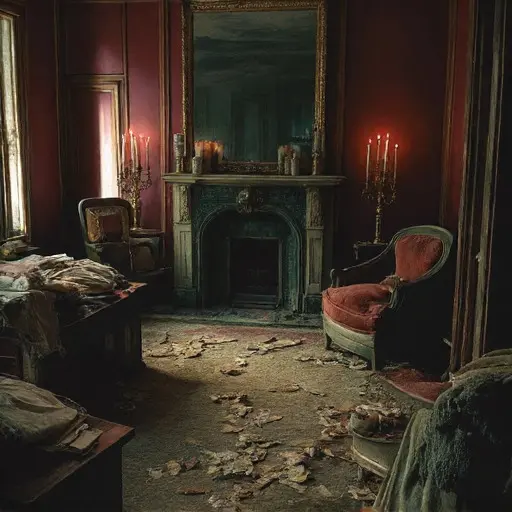
A muted hush fills Fontaine House, settling deepest in the abandoned sitting room, where domestic comforts remain entangled with the quiet obsessions of Lucien Émile Fontaine, a self-taught scientist who never secured a laboratory beyond these four walls. Now a hesitant signal on a fallen page marks the threshold where reason strained against uncertainty, then slipped into silence.
A Signal Through the Scientist’s Evening Ritual
Lucien, born 1875 near Lyon, learned rudimentary mechanics from his father Adrien Fontaine, whose broken chronometer lies on the hearth ledge.
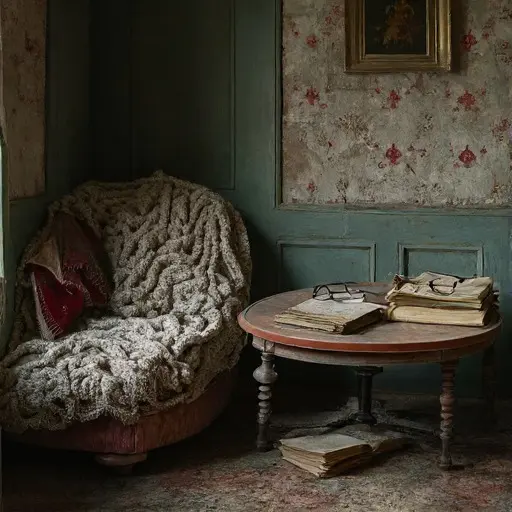
He spent evenings here instead of a workshop—lamp trimmed low, equations balanced on his knee, gears dismantled beside teacups. His order persists: papers bundled with ribbon, ink wells capped though nearly dry, a metronome set precisely at the room’s edge. Even the sag of the upholstery remembers the curve of his lean as he chased meaning through numbers long into the night.
When His Reason Lost Its Direction
Rumors drifted that Lucien submitted flawed calculations to a railway engineer—misjudging stress loads and raising fears of collapse. In the front passage, a box of spare gears lies overturned, brass pieces scattered like errant intentions. Adrien’s chronometer shows a crack across its face, its hands frozen between minutes. A stack of correspondence sits unopened on the console, one envelope half-torn. A folded page displays equations smudged as though pressed beneath a trembling thumb. The signs lean toward distress but offer no explicit confession.
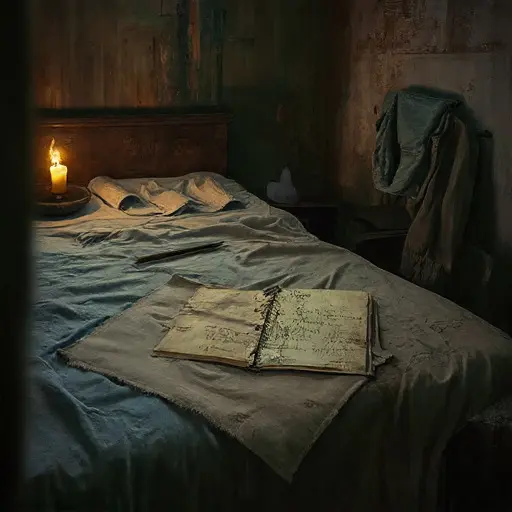
Only the wavering signal remains—a faint gesture toward meaning never fully sought or found. Whatever held Lucien at the margin of comprehension lingers inside these abandoned rooms, quiet as breath withheld.
Fontaine House remains abandoned still.