Silent Nabavi Tea-Room and the Kettle That Hesitated
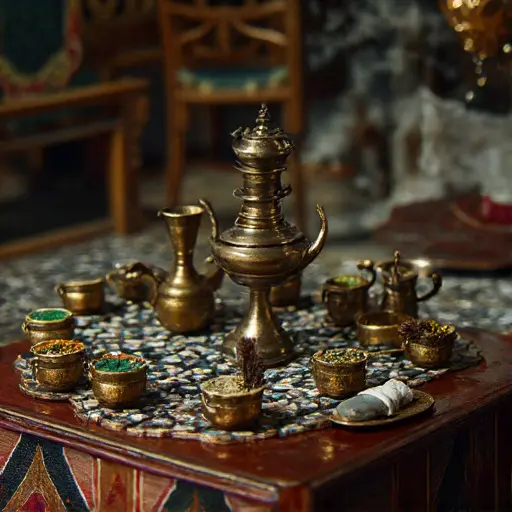
A gentle hush permeates Nabavi House, gathering most deeply in the tea-room, where fragrance once drifted in slow, floral arcs. Here Parviz Farid Nabavi blended teas for gatherings and merchants. Now the angled kettle anchors the stillness, fixing a moment he did not finish.
Even the patterned rug beneath the table seems to steady itself, as if bracing for a step that never came.
Angle in the Tea Master’s Daily Ease
Parviz, tea master, born 1875 in Shiraz, learned brewing subtleties from his grandmother Narges Nabavi, whose brass strainer lies on a folded napkin near the samovar. His mornings began with roasting spices; afternoons steeped in careful tasting; evenings spent refining blends under soft lamplight. His order persists—cups aligned by pattern, spoons grouped by handle shape, tins labeled in looping script. The gentle precision of his work still whispers through the room, shaping a memory of motion that once seemed unbreakable.
When His Infusion Lost Its Balance
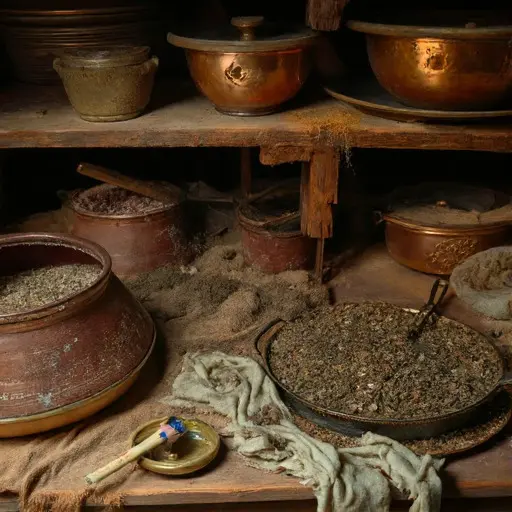
Word rose that Parviz delivered a bitter batch to a respected patron—an unthinkable lapse for him. In the supply corner, a crate of dried saffron threads leans against the wall, one side compressed. Narges’s strainer shows a new dent along the rim. A tasting cup bears a faintly smeared ring, suggesting haste. A ratio slip torn from a notebook lies half-tucked under a tin, ink blurred at the margin. These disquieting traces approach his worry but never fully reveal it, leaving the cause hovering just beyond certainty.
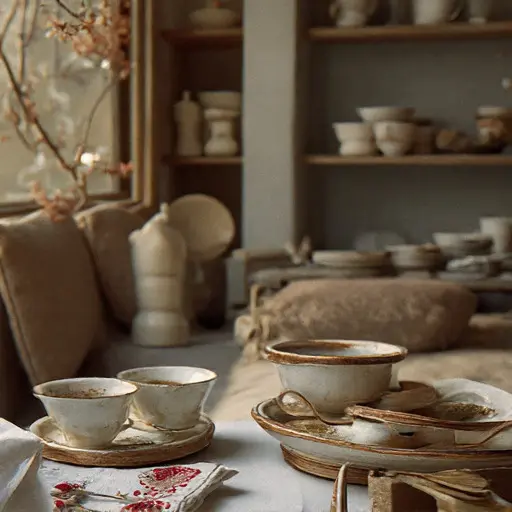
Only the angled kettle remains, poised between intention and retreat. Whatever unsettled Parviz’s final brew lingers in the tea-room’s hushed aromas.
Nabavi House remains abandoned still.