Hidden Bhandari Spice-Room and the Spoon That Tipped

A held hush settles inside Bhandari House, deepest in the spice-room, where sandalwood and cumin hang like memory. Here Arun Dev Bhandari once blended masalas sought throughout the quarter. Now the tipped spoon marks a moment abandoned mid-motion, a quiet imbalance pressing through the room’s precise calm.
Even the faint warmth on the grinding stone seems reluctant to fade.
Tilt in the Spice-Merchant’s Craft
Arun, spice-merchant, born 1875 in Jaipur, worked with meticulous patience refined by family trade. His elder sister, Meera Bhandari, stitched the quilt draped over the lowest shelf. Each morning he roasted seeds until aromatic, cooled them on cotton squares, then ground blends as lanternlight softened the rafters. Evidence of his rhythm lingers—scales aligned on a lattice table, powders arranged by hue, jars wiped clean of residue. Even the smallest fleck of spice appears placed with purpose, echoing his steady temperament.

When His Blends Lost Their Harmony
Whispers rose that Arun’s latest batch tasted “bittered,” as though scorched. In the side pantry, a jar of fenugreek has toppled onto its side, leaving faint trails of dust. A ledger slip shows measurements hurriedly crossed out, strokes uneven. Meera’s stitched quilt bears a small oil stain at its corner. A spice cone wrapped for delivery is crushed at its base, unmatched with any known accident. Even the string used to tie packets lies tangled, defying his usual neat knots, hinting at deeper unrest than he admitted.
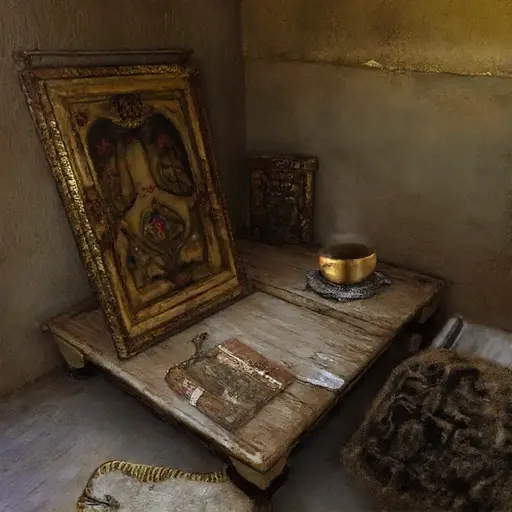
Only the tipped spoon remains, its subtle tilt preserving the instant Arun stepped away. Whatever troubled his final blend rests unspoken in the spice-room’s scented hush.
Bhandari House remains abandoned still.