Hidden Petrov Dye-Cellar and the Vat That Trembled
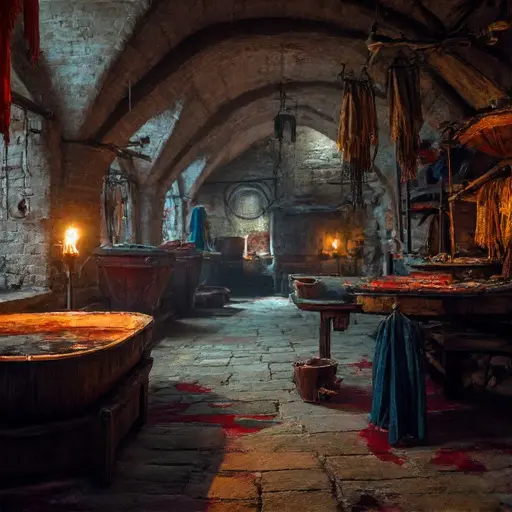
The quiet inside Petrov House thickens in the dye-cellar, where sour-sweet fumes mingle with stagnant warmth. Here Anatoly Sergeyevich Petrov once blended village dyes prized across the steppe. Now the trembling rim of that vat seems to hold the room’s breath, clinging to a moment he left unresolved.
A Ripple in the Dyer’s Patient Craft
Anatoly, textile dyer, born 1872 near Kazan, learned his craft along rivers that carried trade dyes from east to west. A carved birch ladle gifted by his aunt Dunya Petrovna rests on a wool mat near the largest vat. His routine moved with steady purpose: sorting fibers at dawn, adjusting mordants by noon, hanging dyed cloth as dusk cooled the brick. Traces remain—bundles organized by tone, tongs aligned by length, ledger slips tucked between rack beams showing faded symbols of his careful order.
When Color Began to Falter
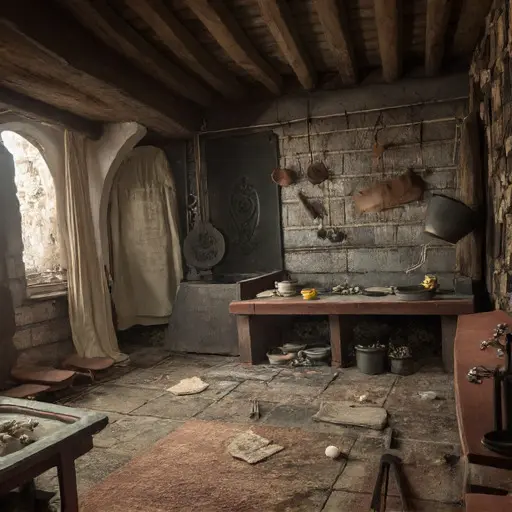
Rumors swirled that Anatoly’s newest dye batch faded after a single wash—a fault unthinkable in his long practice. In the supply recess, a bundle of alum lies burst open, its powder streaking the floor. A wooden sample board bears smeared swatches where he tested hues with an unsteady hand. Dunya’s birch ladle shows a fresh scorch along its handle, not matching the hearth’s usual heat marks. Fiber ropes, once taut, sag loosely as if pulled down in a hurried search for the problem he could not name.
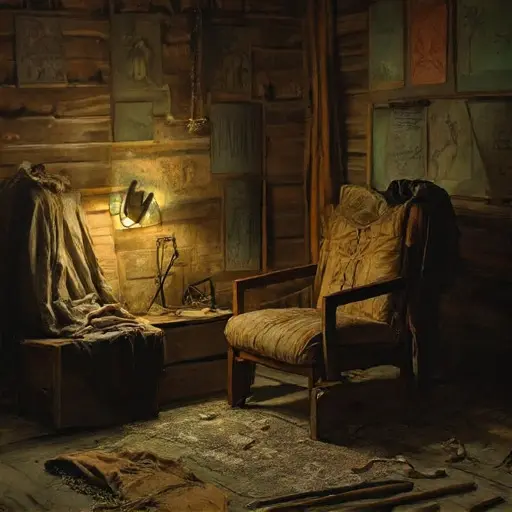
Only the trembling vat remains, its surface holding a ripple that refuses to settle. Whatever thought stayed Anatoly’s hand lingers in the cellar’s warm hush, unspoken and unmended.
Petrov House remains abandoned still.