Forgotten Liu Herbal Hall and the Drawer That Wouldn’t Close
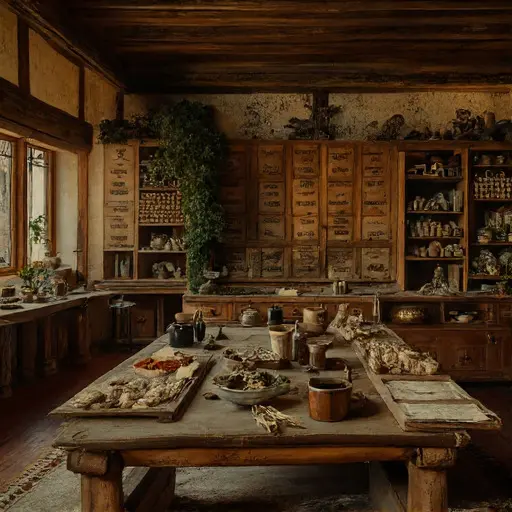
Inside Liu House, silence thickens beneath rafters steeped in medicinal aroma. In the herbal hall, dust gathers on carefully folded prescriptions. Here Liu Zhenhai once prepared remedies that traveled throughout the district.
Now, one drawer’s stubborn gape becomes the quiet center of the room, implying a last moment of hesitation he did not resolve.
The Shift in an Herbalist’s Dedication
Zhenhai, herbalist, born 1875 in Suzhou, apprenticed under his aunt Liu Qingsu, whose fan painted with plum blossoms rests behind the apothecary chest. His routine was orderly: sorting roots at dawn, brewing decoctions by noon, wrapping doses in rice paper by lamplight. He kept meticulous standards—scales balanced precisely, papers folded in tight squares, each drawer aligned by touch. Signs of this care remain in the layered bundles of licorice root and chrysanthemum, stored with reverence.
When Measures Lost Their Balance
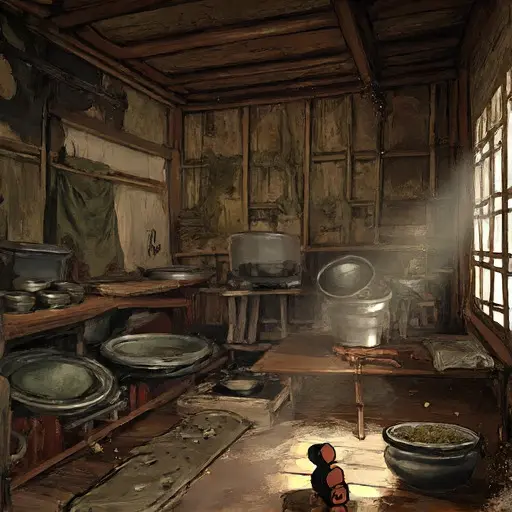
Rumors rose that Zhenhai’s latest tonic worsened a merchant’s illness. In the mixing passage, a bundle of astragalus is crushed underfoot, fibers splayed as though stepped on abruptly. A paper slip noting dosage ratios has smeared ink where a thumb pressed too hard. Qingsu’s fan shows a small tear, its ribs bent slightly out of line. The drawer that won’t close contains roots spilled into its track, but the displacement does not fully explain its stubborn angle—something more subtle unsettled its run.
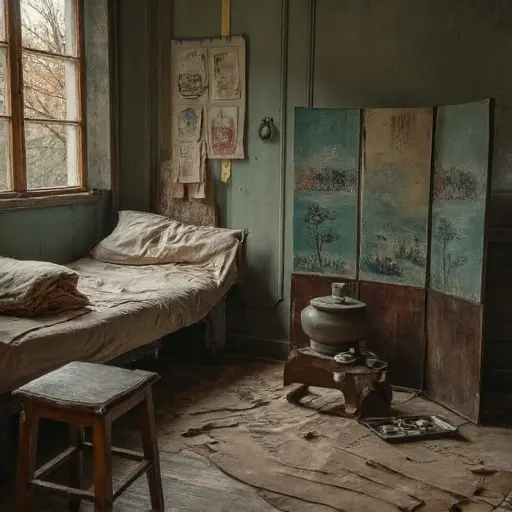
In the end, the single open drawer remains, resisting closure as if echoing Zhenhai’s final unresolved thought. No clue clarifies the moment he stepped away—only this muted shift in a room built on precision.
Liu House remains abandoned still.